Why Better Qualitative Research Runs in CIRCLEs
How connected knowledge improves design, fieldwork, and insight
Qualitative research has always been defined by practical tensions, with deep human understanding constrained by time, scope, and cognitive bandwidth. Even the most capable moderators and ethnographers face natural limits in how much prior work they can review, how much context they can internalize, and how dynamically they can respond in the field.
The problem isn’t skill. It’s structure.
Most qualitative research still runs in straight lines, designed as isolated projects that begin with a kickoff and end with a report. What came before is only partially considered. What comes after rarely benefits.
Better qualitative research runs in CIRCLEs.
State-of-the-art AI systems are now making it possible to design qualitative research as a connected loop, where knowledge accumulates, fieldwork adapts in real time, and insights compound over time. Used well, AI becomes a force multiplier: improving study design, sharpening instruments, personalizing conversations, and enabling synthesis at a scale that was previously impractical.
This article outlines how AI can elevate qualitative rigor when research is designed as a connected system rather than a series of disconnected projects. The approach is illustrated through a CPG engagement led by Finch Brands and powered by Charlie by Finch Brands™️, our proprietary knowledge intelligence platform. The core idea is simple: better context in leads to better results out across each phase of the qualitative process, especially when learning never resets.
The Hidden Constraints of Linear Qual
Most qualitative researchers recognize the structural constraints built into traditional workflows:
- Existing knowledge lives in silos that are rarely fully explored or synthesized holistically.
- Study design is often over simplified due to a lack of foundational understanding at the outset.
- Moderator guides tend to be “one-size-fits-most,” even when audiences and contexts vary meaningfully.
- Analysis becomes a bottleneck, particularly in multi-market or mixed-method studies.
None of this reflects a lack of skill. It reflects a lack of leverage.
The real question is no longer whether researchers could do better with more time and information but whether we now have systems that allow preparation, adaptation, and synthesis to work together as a loop to efficiently go deeper than we have in the past.
Reframing AI’s Role: From Tool to System
AI is often framed in reductive terms: automation, efficiency, replacement. That framing misses the point entirely when it comes to truly human qualitative work.
As a best practice, AI does not replace moderation skill, emotional intelligence, or strategic judgment. Instead, it excels at absorbing large volumes of disparate input, distilling patterns across sources, and enabling personalization at scale.
In Finch Brands’ work, we leverage a Knowledge EmpowermentTM tool called Charlie by Finch Brands TM that is embedded in the research process and used collaboratively by experienced researchers. By accelerating how knowledge is gathered and synthesized, it frees teams to focus on what matters most: understanding people, interpreting meaning, and making thoughtful decisions. AI isn’t the method. It’s the accelerator that helps qualitative research compound value from insights over time.
At Finch, that system is captured in a simple framework.
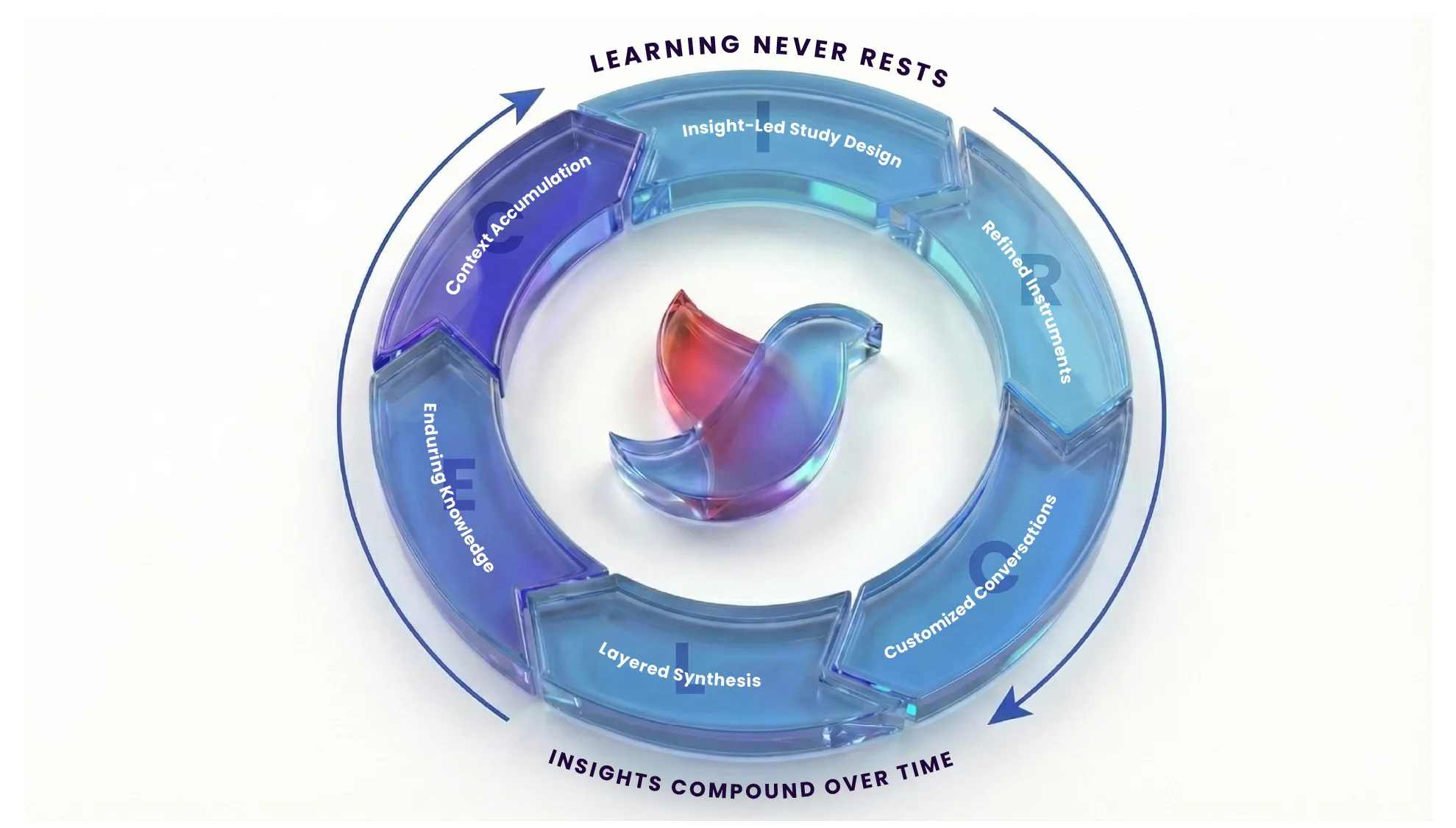
Introducing the CIRCLE Method for Qualitative Research
CIRCLE reframes qualitative research as a loop rather than a linear process. Each phase strengthens the next, and every engagement leaves behind knowledge that builds a foundation for future work.
CIRCLE consists of six connected stages:
- Context Accumulation
- Insight-Led Study Design
- Refined Instruments
- Customized Conversations
- Layered Synthesis
- Enduring Knowledge
C — Context Accumulation
Standing on what’s already known
In a recent CPG engagement focused on tailgating culture, the Finch team began with a foundational question: What already exists that we should understand before going into the field?
Using Charlie’s ability to ingest and synthesize large volumes of unstructured content, the team uncovered nearly a dozen existing academic ethnographies and cultural studies on tailgating that span decades, regions, and disciplinary lenses. This was further expanded by layering additional insight from Charlie’s social intelligence capabilities, which mined insight from sources such as TikTok, Reddit, Instagram, blogs, and more to understand what people were saying, doing, and feeling about tailgating in 2025.
Rather than skimming or selectively referencing this work, Charlie was used to ingest all relevant material, distill shared and divergent themes, normalize terminology, and create a centralized, queryable knowledge base.
The result was a deep cultural insights foundation that allowed researchers to enter the field informed, not cold. At the outset, our team was already fluent in the rituals, meanings, and tensions shaping tailgating behavior.
I — Insight-Led Study Design
Letting patterns shape who and where
One of the most powerful downstream effects of this synthesis was its impact on study design.
By analyzing patterns across academic ethnographies, social discourse, and cultural narratives surfaced through Charlie, the team identified that tailgating culture in the U.S. does not simply vary by team or geography. Instead, it clusters into five distinct regional tailgating cultures, each with unique values, rituals, and food traditions.
These insights directly informed market selection, quota design, and recruitment criteria. Rather than defaulting to conventional regional splits, Finch structured the study around five distinct zones of meaningful cultural variation where traditions, rituals, and food preferences differed, raising confidence that observed differences would be substantive rather than incidental.
R — Refined Instruments
Smarter pre-work and moderator guides
With a robust cultural foundation in place, the research instruments themselves changed.
The knowledge base built in Charlie informed more sophisticated respondent pre-work, sharper learning territories, and moderator guides that were modular and flexible rather than strictly linear. Moderators entered interviews already fluent in tailgating language, rituals, and regional nuance.
This shifted conversations away from basic context-setting and toward deeper exploration of meaning, emotion, and tradeoffs – where qualitative research delivers its greatest value.
C — Customized Conversations
Personalization in the moment
Perhaps the most transformative application of Charlie occurred during fieldwork.
Each respondent’s completed pre-work was fed back into the platform, enabling Finch to generate customized versions of the core moderator guide tailored to each individual household. These guides preserved the study’s strategic backbone while elevating the sections most relevant to each participant and de-emphasizing less meaningful areas.
The impact was immediate. In-home conversations felt more personal and respectful. Respondents recognized that moderators already understood their context and priorities. Time was spent where it mattered most, not covering unnecessary ground.
This approach enabled mass customization without sacrificing comparability, a long-standing tension in qualitative design.
L — Layered Synthesis
From depth to direction
After fieldwork, the CIRCLE loop continued.
Charlie was now populated with foundational client strategy documents, academic ethnographies, social intelligence data, and full transcripts from every tailgate interview and in-home visit. With everything centralized, the team could explore macro-level themes across regions, examine micro-level nuances within specific cultural contexts, rapidly retrieve supporting quotes, and pressure-test hypotheses across multiple data layers.
Rather than choosing between depth and scale, the research delivered both.
E — Enduring Knowledge
Turning outputs into future inputs
What ultimately differentiates CIRCLE is the final step.
All learnings including frameworks, themes, transcripts, quotes, and regional nuance are captured within Charlie as part of a growing knowledge estate. Instead of research outputs being archived and forgotten, they become active inputs for the next engagement.
Every project makes the system smarter. Every study raises the starting line.
What This Means for the Future of Qualitative Research
The next era of qualitative excellence will not be defined solely by moderation skill or methodological purity, but by how intelligently teams connect, activate, and preserve knowledge.
When systems like Charlie are paired with skilled, human-led research teams, qualitative research becomes more personal, more rigorous, and more impactful. Better questions are asked earlier. Respondent time is used more meaningfully and insights travel farther in the organization.
The future of qual isn’t AI instead of people. It’s people working in CIRCLEs, supported by systems that ensure their best thinking is fully activated and the value of effectively designed qual compounds over time.
About the Author
John Ferreira is Chief Insights Officer at Finch Brands, where he leads insights innovation at the intersection of deep human expertise and artificial intelligence. His work spans qualitative and quantitative research, cultural intelligence, and the design of connected insight systems that help organizations turn learning into enduring knowledge. Prior to Finch, John held roles in insights and brand management at Campbell Soup Company. He is a graduate of the Saint Joseph’s University Haub School of Business and the Wharton School of Business at Penn.