Webinar: How AI Can Make Qualitative Research More Human
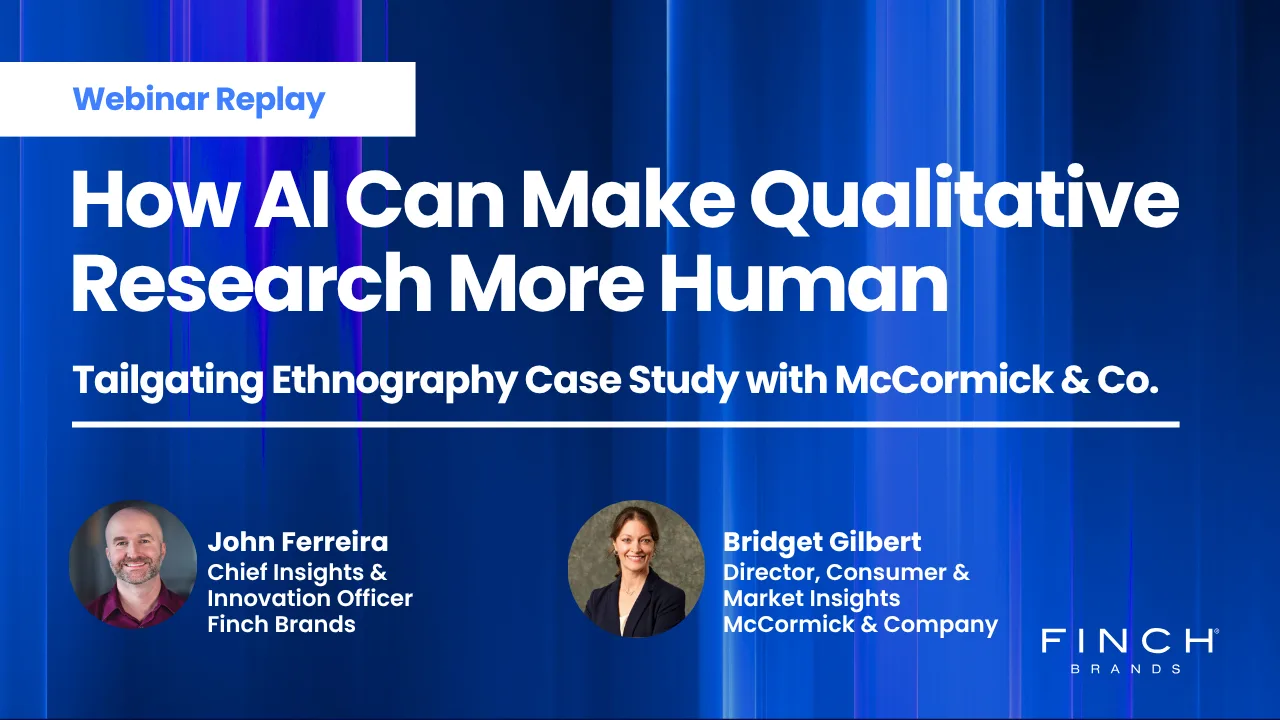
John Ferreira, Chief Insights Officer at Finch Brands, and Bridget Gilbert, Director of Insights at McCormick & Company, walk you through an immersive tailgating ethnography—and reveal how AI was used not to replace human insight, but to strengthen it.
Together, they’ll show you how blending live, in‑person immersion with our AI‑powered learning platform, Charlie by Finch Brands™️ , can unlock deeper empathy, smarter design, and more actionable outcomes.
You’ll learn:
– Why some culturally and emotionally rich topics can’t be understood from behind a screen
– How AI can enhance live qualitative research through better preparation, personalization, and analysis
– A practical “learning loops” framework that fuses human judgment with AI pattern recognition
– How to scale qualitative learnings without losing presence, nuance, or meaning
This webinar is designed for insights leaders, researchers, strategists, and brand teams who are navigating the future of qualitative research—and want to design for presence and progress, not one or the other.
To learn more about Charlie and schedule a demo – reach out here!
How AI Can Make Qualitative Research More Human: A Tailgating Ethnography Case Study with McCormick & Co.
Webinar Transcript: How AI Can Make Qualitative Research More Human
[John Ferreira]
Thank you everyone for attending our webinar on “How AI Can Make Qualitative Research More Human”. We are presenting together, McCormick and Finch Brands, on a case study about tailgating ethnography and how there really is this new avenue that’s opening up between traditional while and AI-driven online. So as a quick introduction, my name is John Ferreira, I’m Chief Insights Officer at Finch Brands.
Finch Brands is an insights-driven brand consultancy and I’ve been at Finch for 12 years now. And prior to that, I worked at Campbell’s Soup Company in brand management and consumer insights. And my tech team partner today is Bridget Gilbert.
[Bridget Gilbert]
Yes, thank you. Hi, I’m Bridget Gilbert, a director on the insight team at McCormick. I’ve been with McCormick for about two years, joining after spending several years leading insights for the Purell brand through the pandemic.
Prior to that, I spent most of my career agency side within the WPP network, where I worked on a diverse mix of brands, primarily leading insight generation for retail activation.
[John Ferreira]
Right, so let’s dive in here. So starting big picture, if we think about the world of traditional qual, not much has changed over the years. So from 2026 to 1986, it’s pretty much the same laboratory, it’s pretty much the same tools.
And a case can be made that in-person qual is more important than ever, but we really have to ask ourselves if the techniques are keeping up. And then on the flip side, a whole new world of online qual and AI-driven qual is opening up and expanding from sort of TikTok style collection of clips at a scale that mirrors quant to now the use of synthetic data and AI-driven moderation. And I think what we’re finding is there’s really, there is a time and there is a place for these different tools, but when it comes to some of the deeper, richer traditional qualitative questions, you know, the question if you’re, you know, are synthetic personas going to get you that true rich detail, for example, or if you have a collection of 30 different six second clips, how well can you really get to know someone in that moment? So that’s sort of the other end of the spectrum.
And each has their own strengths and limitations for traditional qual, it’s the depth, it’s the physical presence, it’s the empathy, but as we mentioned, the formula really hasn’t been updated in a long time. Most of it’s the same cookie cutter mod guides, everybody gets the same experience. It’s hard to scale and it’s an investment, it’s time consuming.
On the flip side, you can go fast, scalable, efficient with increasing personalization on the AI side, but for certain questions, you have to ask yourself, is the humanity there or the, is the attention of our own stakeholders that are following research, is that divided and are meaningful moments just reduced to sound bites? But what if this wasn’t a discrete choice? What if there was a third path here?
That’s really what we explored together at Finch, Brands and McCormick, and that’s what we’re going to talk to you about today.
[Bridget Gilbert]
Yeah, we really live in a world where so much of our time is spent staring at screens. Often we’re multitasking, we’re distracted and half present. And at McCormick, we’ve been really intentional about pushing back on that.
We’ve made an ongoing effort to get out from behind our screens and meet people where they actually live their lives in real moments and real environments. And we found that there’s something fundamentally different that happens when you’re physically present. Everyone is fully there.
There’s no quiet multitasking. When that happens, the energy shifts and you notice things that you would never catch through a screen, like the way people move through a space and how they’re interacting with one another, what feels joyful, what feels tense, what feels sacred. Those experiences and insights really stick with you long after the research is complete.
So we are now almost two years into a company-wide push toward this more immersive research, bringing brand leaders and cross-functional partners into the field when it makes sense. And the goal is simple, to build deeper understanding, build empathy and use that to build our business. Tailgating is a critical moment for McCormick, of course, because it drives meaningful volume, but also because it’s an opportunity for us to connect more meaningfully with consumers.
It’s a moment where flavor isn’t just functional, it’s emotional, it’s social, and it’s deeply ritualized. And because McCormick brands exist to show up in those real-life flavor moments, we can’t be satisfied with simply knowing what people buy. Sauces, seasonings, heat, these aren’t background elements, they’re how people express identity and pride.
And it spans multiple brands and categories across our portfolio. Of course, tailgating is not a single occasion, it’s a season-long ritual. So if we wanted to truly understand it, we couldn’t just zoom in on one moment.
We had to understand that full-lived journey. And that meant designing research that could deliver on foresight and empathy and action, not in isolation, but together. When you really look at tailgating, you realize it’s not just a pregame event.
For some people, this starts in college and follows them for decades. It moves with them from campus to career, from one city to another. It’s regional, it’s generational.
Recipes get passed down, rivalries get passed on. It unfolds across the whole season. There’s anticipation during the week, preparation on Saturday, gathering on Sunday, and then stories that are retold all week long.
It has the emotional weight of a holiday, but the lightness of a casual gathering that happens over and over. And in the middle of all that, flavor isn’t just food, it’s identity, it’s belonging. That’s the kind of complexity we were stepping into.
This isn’t just about what’s on the grill. This is culture, not just consumption. With a topic this socially, emotionally, and culturally complex, we quickly decided that AI-driven online qual wasn’t going to be the right fit for this particular project.
Tailgating is too layered to study from a distance. You can’t fully understand a ritual just by asking people to describe it on a screen. You have to be there with no distractions, no multitasking, just presence.
Because when something carries identity and tradition, you don’t just hear it, you can feel it. And we couldn’t risk missing that. On the other hand of the spectrum, some of same dynamics around how deep, rich, and nuanced this topic was meant that traditional qual alone wasn’t going to be the right fit either.
When culture is complex, you can’t just run a template. We couldn’t lock scope before we understood the terrain. We couldn’t rely on one-size-fits-all guides to expect to uncover that nuance.
Simply reporting high-level themes wasn’t going to move the business. If we treated this like a standard project, we’d get standard answers, and that wasn’t enough.
[John Ferreira]
So after exploring those two ends of the spectrum, we flipped the question and we asked ourselves, what if AI could make live qual more human? What if it helped to shape the plan and shape the emergence of replacing it? Helped us prepare better, to design smarter, and really to get to know people on a deeper level.
Would that be possible? And if so, how might we do that? And the way that we came up to do that was with this learning system.
We call them learning loops, and they’re connected human and AI learning paths where you get the best of the human analyst and you get the best of the AI tool set. You bring them together into a combination of live and online qual through this system called loops. Loops stands for learning the landscape, orienting the approach, observing in context, point meaning, and storing and scaling your insights.
And we’ll talk through that in a moment. But just as a quick overview, you want to have a great online tool when you’re doing qualitative research. The tool that we use is called Charlie by Finch Brands.
This is something that we’ve co-developed with a technology partner, and we chose Charlie because it can see more broadly and more deeply than sort of the off-the-shelf AI tools, whether that’s a Gemini or Chatsheet-T or other tools, particularly across social resources in places like academia, product reviews in different places. So we were able to scan broadly and deeply, and that’s what made it the right tool for us. But I’m sure you have your own preferred AI tool that you’re using, Claude, Gemini, whatever that might be.
And you can certainly apply a lot of the concepts that we’re going to talk about today using your own favorite AI tool. So loops starts with a learning phase, learning the landscape. We think of this as immersion before the immersion.
And as we pointed Charlie in the right direction, we wanted to say, you know, what could we learn at the outset to help us approach this in a smarter way? We found first that there were 10 different ethnographic research studies from academia on this particular topic that had been completed over 20 years. So we used that as a really rich insights foundation to be able to bring that into the project, sort of accelerate the starting point for where we would be from a learning perspective and create a smarter proposal.
Within Charlie, we also analyzed at scale and segmented social media conversations to discover that there were a whole range of distinct regions across the country that we needed to take into account in our learning plan. So this began with the context to guide our curiosity, and we ended up becoming quickly fluent in the motivations, archetypes, traditions, rituals, trends, lifelong fan journeys, and an initial point of view on the critical role of food all before the research project even started. And what that did was it helped us to orient the approach in a smarter way at the outset in steady design.
And then when we got into the process as well to create a higher level of personalization, tailgating certainly isn’t one size fits all. So we wanted to make sure that this was truly customized in a way that would unlock the depth and the richness of this topic. I mentioned we found these five different behavioral and cultural zones.
That translated into, okay, we’re going to do the online, we’re going to do the in-person research, tailgating intercepts and observation. We’re going to do in-homes. We want to complement that by casting a wide net with IDIs across the country to talk to tailgaters and at-home hosts so we can make sure that the geographic diversity of viewpoints was fully accounted for.
And then as we got into the research workflow, everything we learned from the learning phase helped to create a better starting point for mod guides. But we didn’t stop there. We did pre-work for each respondent that was a scheduled interview.
And then we personalized that mod guide down to that individual based on what they had shared. And that created a greater sense of connection because they felt listened to and understood. And it also steered us toward where were the areas of greatest depth or leverage within the conversations to allow us to spend time in the places that mattered.
And that really helped the research process.
[Bridget Gilbert]
Yeah. And using Charlie to do this pre-work helped the team develop not only a strong proposal, but really jump-started the work before we even formally kicked it off on our side, which helped us drive excitement and commitment as we engaged our business partners. So observing in context, this is where the work really came alive.
We weren’t just observing tailgating from a distance. We were in it. Tailgates, homes, and stores.
Watching, listening, participating across that full range of realities that people build these rituals around. From seriously frigid temperatures in Green Bay and laid-back sunshine on a college campus in Alabama, people were welcoming us into their traditions. And while AI played an important role, it stayed firmly backstage.
That balance really mattered because we didn’t just hear people talk about camaraderie. We felt it. The warmth, the cold, the pride, the sense of belonging that surrounds tailgating culture.
AI helped us enter fluently, giving moderators context on local legends and regional traditions, but it never replaced human judgment in the moment. The result was deeper engagement, stronger emotional connection, and a richer set of assets that made the later analysis far more powerful.
[John Ferreira]
And then moving into the analysis phase, it’s all about pulling meaning from the experience. So at this point, we had a treasure trove of assets. We had the full analysis of the 10 different ethnographies that we were able to gather from across the web.
We had all the analysis from social intelligence. We had a video and transcript of any interview we conducted anywhere, whether that was in person at the observation and intercepts, whether that was in homes, whether that was the online IDIs, or in-store chopper interviews. This all created, we think of it as a rich qualitative database of learnings that allowed us to operate it both at the macro level and the micro level.
And it truly was an iterative process of us as human analysts who had been there and talked to these people to understand them and sort of feel what they were saying at the same time, combined with the granularity that AI can bring to the process and the pattern recognition that it has. I think the biggest, most actionable insight we found from the whole study was actually human-generated. AI didn’t know enough to know that it was something that was important.
So it had all the artifacts, but it didn’t have the context or the judgment and the ability to translate that into, wow, this really is white space. This is new and different thinking. This is an opportunity in the marketplace.
But at the same time, translating this down into activation across a full omni-channel journey around how can McCormick squeeze every last ounce of value out of this and from big strategies to sort of micro opportunities along that omni-channel journey, we wanted to make sure that no stone was left unturned. And we have this perpetual asset now to being able to answer those specific questions and come up with those specific strategies.
[Bridget Gilbert]
So store and scale learnings. This was one of the most important payoffs for us that came after the field work ended. Too often, learning resets once a project is delivered and the next team starts from scratch.
We wanted to break that cycle. We connected what we learned through this immersion to existing knowledge. So each study is then raising the starting line for the next one.
That context didn’t disappear when the project ended. It carried forward. And that meant insights became more actionable for stakeholders because they were grounded in that growing, connected body of understanding.
So instead of isolated learnings here and there, we were compounding our return on insights over time. And that’s what makes this approach really sustainable. Not just inspiring, but operationally valuable.
[John Ferreira]
So having found this third path and discovered that it worked and gone through this experience together, we really came through the process with several new beliefs about the future of qualitative research. And the first is you don’t have to choose between presence and progress, between traditional qual and some of the new capabilities of that AI and advanced online quality bringing the process. There really are creative ways to fuse those two together to get the best of both worlds.
And from an immersion standpoint, we do firmly believe now that AI tools in the right hands of the right creative and talented researchers can unlock a whole new level of exploration and personalization, which at the end of the day, deepens that human immersion, both for us as researchers, for stakeholders that are along for the ride on the journey, and for the respondents themselves that feel even more deeply understood.
[Bridget Gilbert]
Now, at the beginning, we showed two extremes, frozen traditional qual and hyper accelerated synthetic qual. And it can feel sometimes like we’re being asked to choose, but presence and progress were never meant to compete. Presence gives us empathy and brings that energy into the room.
And progress gives us clarity and helps sharpen what we bring into the room. The future is not about replacing the human, it’s about strengthening the human. In tailgating, we didn’t automate immersion, we prepared for it.
We didn’t simulate ritual, we stepped into it with more intelligence. AI helped us enter smarter. Humans did the sensing, adapting, and connecting.
Presence without progress gets stale. Progress without presence feels hollow. The real opportunity is designing for both from the start.
When we design for both presence and progress, qualitative research becomes more human, not less.
[John Ferreira]
All right, everybody, well, thank you for for joining us on this webinar. Bridget is unfortunately not able to stay for the Q&A, but Bridget, appreciate all of your partnership here throughout the process. And if we do have any follow-up questions that would be specific to Bridget, we can certainly follow up with any individuals on those answers.
But I am here to answer any questions you have. So looks like Rachel in the chat, the slide with the bubbles. So I think that was the L slide in the learning loops.
And really, what that slide was illustrating was just the various different ethnographic studies that we’re able to identify at the outset. It really blew me away that there was that much existing ethnographic research on this topic, and that the starting point for this process could be kind of so far down the track. It kind of makes sense when you think about it.
There’s probably no topic that’s easier for college professors to study from an anthropological perspective than rolling out of bed, driving over to campus, and then just observing football games. But there were many different studies, a bunch from Notre Dame, some from the SEC in particular, probably more college than NFL. And we learned so much at the outset.
And this was even before we agreed to be partners on the project. We just wanted to get really smart to make sure we could design the smartest possible methodology and really know the contours of the topic to think about things like the structure of sample and what sorts of voices do we want to be able to hear from the outset and make the mod guide stronger, et cetera. So that’s really what that slide was all about.
Feel free to pop any other questions in the chat that anyone may have. But one pre-submitted question here, how do you know when a topic is too complex for a traditional approach? I think we as researchers, you all have that gut feeling and intuition when you know something is going to stretch beyond the functional into a more of an emotional space.
So we had that at the outset. But the really, really of it is when you do activate that process and you start to explore. So from my perspective, things like social media conversations are probably the richest ethnographic data set that’s ever been created.
And if you have the right tools to mine that, this is a topic that people gush about. People open up. They share their stories.
They share their traditions. They did it with us in person. They do it every day online.
So we were really able to see a lot early. And that was sort of the signal of, wow, OK, the in-person component of this is going to be particularly important because seeing that, experiencing it, experiencing that and feeling it up close, you’ll be able to get people to really open up both from an observational perspective but also from a conversational perspective. And we found everybody has a story about tailgating if you’re engaged in that culture in some way, shape, or form.
And that can be small moments or lifetime cross-generational traditions that people want to speak to. Some people even sort of tiered up talking about sort of friends or family who had been part of past traditions but had passed on and the ways that they honored them at tailgates. So it blew me away in terms of how rich and how deep and how emotional this is.
But you can learn that right at the outset if you’re using the right tools to explore what people are saying. Probably harder to do in B2B than it would be in B2C, I would say, but it can work in a lot of different categories. Let’s see some additional questions.
Why was one college a collegiate team in the middle? I’m not sure. I think that was a graphic designed by our team.
We did study college football and we did study the NFL. We also studied regular season and we studied Super Bowl. So it started with the ethnographic research that we explored from an online perspective with the Charlie tool.
We did national IDIs to make sure we had regional representation. We did in-person research down in Alabama, both observing people at tailgating as well as having people opt in to tell us their stories. We also went up the NFL in 10 degree weather up in Green Bay.
And we also did some secondary research just to figure out where could we get two very distinct experiences and where they’re going to be diehard fan bases. So Alabama and Green Bay, definitely check those boxes. We did in-store, a shop of research as well, going through people’s journeys.
And we also had people document their Super Bowl experiences. It’s harder to get people to agree to let you into their homes for Super Bowl because of how big and how special that is. But we were able to have people document that and then do interviews after the fact to go into the experiences that they documented.
Let’s see, another question. Have we been able to productize this approach? No two use cases are the same, but have you built a playbook used to repeat this efficiently and smarter?
Yes, the loops process itself is a process that we are regularly using at Finch Brands. Again, not applicable in every situation, but we are finding that it transfers across many different industries in many different spaces. And the friction and the effort it takes to do really smart secondary to create better, more finely tuned and tailored proposals has really gone down as AI tools have become more powerful.
So in the right hands of the right researcher asking the right questions, it is enabling us to create more effective methodologies that are finely tuned to client objectives. So we are productizing that approach, and it’s an approach that we encourage. We really think research is sort of headed in that direction across those different aspects of the loop process.
So encourage others to adopt that sort of mindset. Another question I had here is what was a moment that you would never have captured in a survey or focus group that came out through the process? And I can think of a bunch of them.
The example of people talking about sort of folks that were really close to them and how they honored them, even though they were not there at the tailgate anymore, would definitely fall into that camp. But it was just a twinkle in people’s eyes when they talked to us about tailgating and their own story and what it means in their life and how it connects them to other people. You know, that twinkle I don’t think would have come through in a webcam like it came through when you’re right there in the moment.
And people are not talking about the hospitality, but they’re showing you the hospitality. Even we saw rival fan bases where normally you would think there’d be a lot of trash talk and things along those lines. But it’s just a really special sort of bubble where this exists.
And it just brings people together, even where people have differences in everyday life. When you’re at that tailgate, maybe with a few rivalry exceptions, few things unify people like a good tailgate or a good watch party. I also remember there was a hot sauce challenge for one particular group of fans where they had a pretty hot variety of hot sauce.
And at the outset you would place bets on which team you were rooting for and the losers would have to take hot sauce shots. So all sorts of fun little niche nuance micro traditions that are expressions of sort of the broader culture surrounding tailgating. But we learned a ton.
It was a lot of fun. And now we’ve really helped collaborating with Bridget and her insights team really unpack these insights across the full phase of the omni-channel experience so we can turn this into actionable strategies for McCormick to grow their brand. So I think that’s everything that we have.
But if you have any other questions, please feel free to submit them to us at any time, whether it’s for us or Bridget, and we’d be excited to help to answer them. So thank you much. John Ferreira here at Finch Brands and stay tuned for the next webinar.
Thank you.