Webinar: Choosing the Right Insight Community Partner
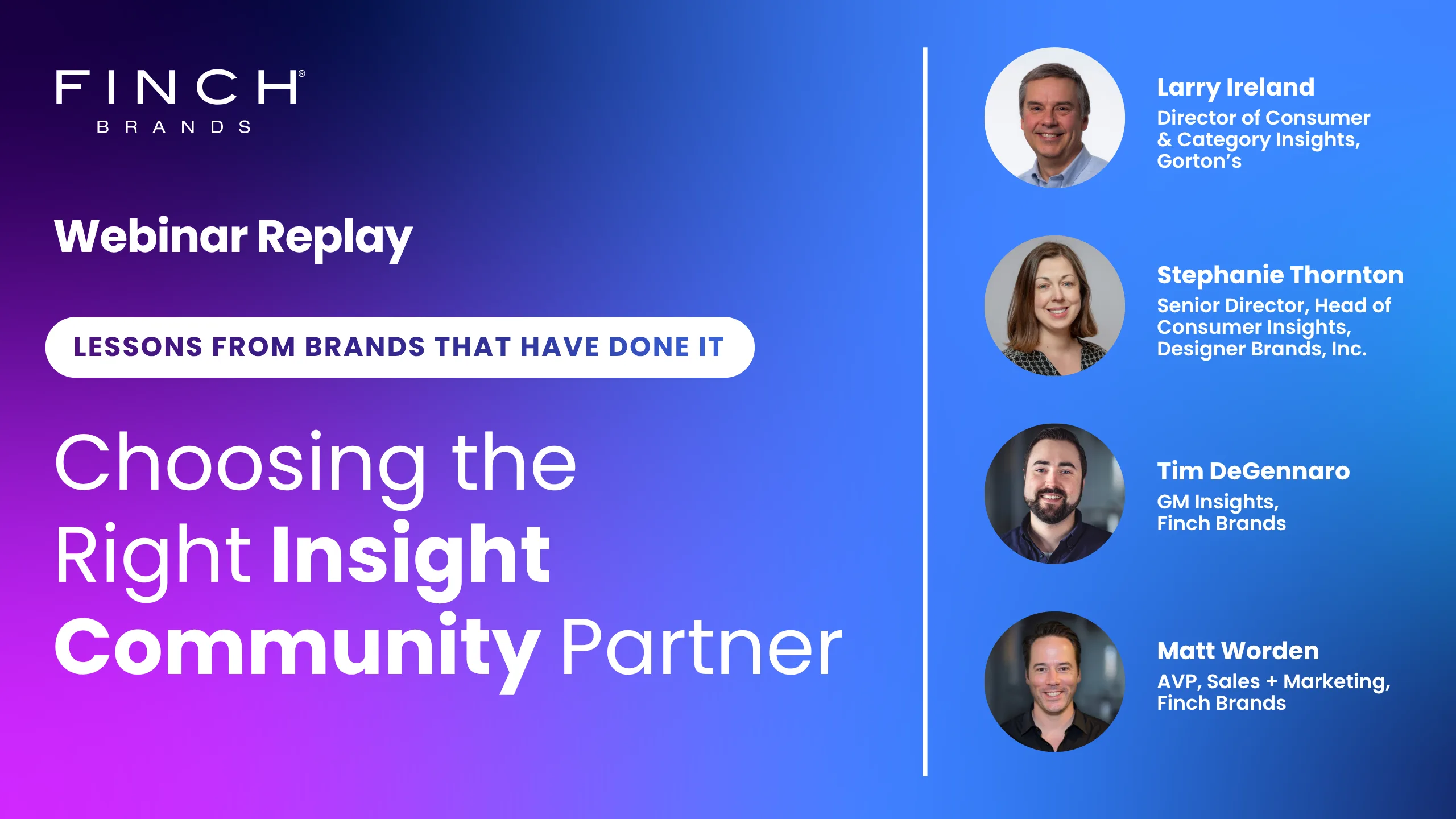
Selecting the right insight community partner is one of the most important decisions an insights team can make. Whether you’re launching a new community or evaluating an existing provider relationship, the stakes are high. The right partner can accelerate learning, strengthen stakeholder engagement, and help your program evolve with changing business needs. The wrong partner can limit growth and create unnecessary challenges.
Finch Brands was proud to host a candid panel discussion featuring two insights leaders who recently faced this decision from very different perspectives. Larry Ireland, Director of Consumer & Category Insights at Gorton’s, share lessons from evaluating an established community and making the decision to transition to a new partner. Stephanie Thornton, Senior Director, Head of Consumer Insights at Designer Brands, Inc., discuss the process of selecting a partner for a new insight community, including how her team defined requirements, evaluated potential providers, and determined the best fit for their long-term goals.
Together, they provided a practical, real-world look at what matters most when evaluating community partners and making one of the most important investments in an insights program.
Full Transcript
MATT WORDEN
Welcome to Choosing the Right Insight Community Partner, a panel discussion with insights leaders at real companies who have recently evaluated the field and chosen a community partner. I’m Matt Worden, and I lead client development at Finch Brands. I’ll be your moderator for today’s discussion.
To put all the cards on the table, we have more than 30 ongoing thought-leadership insight communities at Finch. Yes, we have an interest, but we also believe this is a beneficial discussion because sometimes you simply don’t know what to ask. Finch sits at the intersection of customer understanding and brand building. We help brands when it matters most.
I’m joined by leaders from two brands we support: Gorton’s and Designer Brands, the parent company of DSW. Larry Ireland is Director of Consumer and Category Insights at Gorton’s. Stephanie Thornton is Senior Director of Consumer Insights at Designer Brands. Tim DiGerno, GM of Insights at Finch Brands, leads our community business.
Today we’ll walk through the decision-making process chronologically: the experiences that shaped the search, the information that mattered, and what ultimately led to the final decision. Stephanie, you can go first.
You’re both experienced with insight communities. How did those experiences shape what you were looking for this time?
STEPHANIE THORNTON
Absolutely. I’ve worked with several insight communities during my career, probably most of the major names at one point or another. Those experiences taught me that, with the wrong partner, you can spend so much time going back and forth on requirements, study design, analysis, and reporting that you could have completed the project yourself. Finding the right partner matters. Otherwise, why not simply do the work ourselves?
MATT WORDEN
Right. Larry, any thoughts?
LARRY IRELAND
In addition to leading insights at Gorton’s, I previously worked on the agency side, including for a community provider. I’ve been on both sides of the desk and have also been a client of different community providers. We don’t have a large research budget, and I like being in the weeds and working directly with the data. I wanted a hybrid DIY and full-service offering: a trusted team I could hand projects to when needed, plus a technology platform that would let me program surveys, analyze data, and produce reports myself.
MATT WORDEN
What triggered your desire to switch? You were with an incumbent and decided to look elsewhere. What changed?
LARRY IRELAND
We were approaching renewal, but I opened the search for two reasons. First, I wasn’t satisfied with the technology platform. It felt homegrown and assembled over time, with different components bolted on. It wasn’t user-friendly. I sometimes had to visit three dashboards just to pull frequencies.
The final trigger was the account and research team. It had become a revolving door, and the team no longer felt effective for me. They didn’t know me, my business, or my expectations well enough to add value or apply a strategic lens when I handed them a project. When both the platform and service deteriorated, I knew I needed to look around.
TIM DEGENNARO
That point about a fragmented platform is important. Having everything native in one platform makes it easier for clients to use and makes the delivery team more efficient when completing full-service work. Everyone benefits when the work happens within one native platform.
MATT WORDEN
Stephanie, Designer Brands was starting from scratch. What triggered the decision to build a community?
STEPHANIE THORNTON
My team and I understood the value of an insights community from prior roles. We felt we were missing a critically important tool and couldn’t do our jobs as well without it. Loyalty research helped move the organization forward. Our most engaged customers told us they didn’t feel they had a two-way conversation with us. It felt like we were talking at them rather than hearing their voices.
STEPHANIE THORNTON
As our loyalty marketing team prepared to relaunch the program, we wanted feedback throughout the process from our most engaged customers. We also knew the community could support many other use cases across the business.
MATT WORDEN
That’s powerful.
Once you identify the need to switch or build, you have to evaluate the market.
What questions helped you cut through the pitch and understand how a partner would actually show up?
STEPHANIE THORNTON
We began with a large requirements spreadsheet developed with our strategic sourcing partners. The first RFP responses were difficult to compare. Each provider used different credits, panel sizes, activity counts, and definitions. The most differentiating question was turning it back to the potential partners: What do you recommend? Here is our customer file and what we’re trying to achieve. How large should the community be? How many activities should we conduct?
Many vendors will simply price the requirements you provide. We wanted partners who would advise us and say how we should approach the work. Thought partnership during the RFP process made the difference.
LARRY IRELAND
Because the platform was a major concern for me, I wanted more than a demo. I wanted hands-on access. Some providers allowed it and others did not. I needed to know whether the platform was robust enough for my needs while remaining user-friendly.
I also did significant legwork outside the formal process. This is a small industry, so I asked colleagues at other companies and agencies about their experiences. What I heard was very telling and helped narrow the choice.
STEPHANIE THORNTON
A community partner is a long-term relationship, not a one-off project. That makes case studies, references, and conversations with people who have worked with the provider especially important. You need to know whether the provider is a good partner because you’re in it for the long term.
MATT WORDEN
Larry, how did the long-term nature of the relationship change your evaluation?
LARRY IRELAND
It changed it significantly. For a one-off project, expertise, experience, and capabilities may carry the most weight. With a community, you’re signing up for at least a year and hopefully longer. Do you trust the people? Are they listening to your needs and designing a solution around them, or fitting you into a cookie-cutter package? Do you trust the research team to be there for you? You want to feel confident in the relationship from the start.
MATT WORDEN
What were the biggest mental hurdles in leaving an incumbent partner, and what did you expect to be hardest about switching?
LARRY IRELAND
The biggest hurdle was fear. Change is scary. Gorton’s had worked with the prior community provider for about 15 years. Recommending someone new created resistance because the community was widely used across the organization. I needed confidence that the switch was the right decision.
Budget was another hurdle. Starting from scratch and recruiting a new community would have been a nonstarter. Then I learned we could take the members with us because we had paid for the recruit. That opened the door. We loved our community and had invested heavily in its vibrancy. Losing those members would have set us back.
Once I understood that migration was feasible and that we were unlikely to lose many members, I had confidence moving forward. We did not lose a significant share, and that was essential to making the switch.
TIM DEGENNARO
Migration is a technical barrier for many prospects. We described it like moving contacts from an iPhone to an Android phone. Members don’t feel the database transfer or receive a disruptive notification. Once that clicked, the process felt much more manageable.
LARRY IRELAND
More than 90 percent of our members made the switch. From their perspective, it was seamless. The community was unavailable over a weekend, and members returned Monday to a new experience. A satisfaction poll about three months later showed that the vast majority considered the new community an improvement. It was a win for us and for our members.
STEPHANIE THORNTON
That’s helpful. It had never occurred to me how easy it could be to port a community over.
MATT WORDEN
Stephanie, when choosing a first community partner, what did you prioritize?
STEPHANIE THORNTON
Budgets are tight across insights departments, and retail has been challenging. We’re all trying to stretch every dollar while delivering quality. DIY capability was important because it lets us complete quick-turn projects and extend our budget.
The community uses the My-Take platform. We also considered contracting directly with My-Take and doing everything ourselves. The platform worked well, but when we explained our needs, even My-Take recommended working with Finch because we also needed thought partnership.
We’re a small team without a lot of headcount. We needed a partner who would feel like an extension of our team. Finch demonstrated that through the RFP process, recommendations from others, and my own previous experience working with Finch at Gap Inc. The team doesn’t feel like a vendor we toss projects to. They know our business, anticipate our needs, and don’t require a deep briefing every time. The combination of DIY capability and true thought partnership was critical.
MATT WORDEN
Larry, given what you saw in the market, what tipped the scales toward Finch?
LARRY IRELAND
It was the custom solution. I pushed for an approach designed around my needs, and Finch listened and returned with a solution that met them. I had confidence in the platform and research team, along with flexibility in how I could use research credits. That matters because research needs change. What I expect to need today may be different six months from now. Feeling heard and having a flexible, custom solution tipped the scales.
MATT WORDEN
Stephanie, what pleasantly surprised you once you began working with Finch?
STEPHANIE THORNTON
Two things stand out. First, the My-Take platform had a much gentler learning curve than I expected. I programmed the first survey myself, and by the second I felt as if I had been using it for years.
Second, the Finch team truly feels like an extension of ours. During a period of team transitions, we gave Finch a brief and asked them to run the survey, analysis, and reporting. When I reviewed the report, I had no notes. It was clear, well-articulated, and strong enough to fuel our store innovation pipeline for years. It is rewarding when the work lands with that level of impact without 10 rounds of back-and-forth.
MATT WORDEN
What would you say to someone who feels stuck with a current partner and isn’t sure something better is available?
LARRY IRELAND
Do the legwork. There’s no harm in looking, and you may be surprised by what you learn. Talk with other organizations, agencies, and peers. If you think the cost of starting a new community has you trapped, remember that migration may not be a barrier. Members can often move with you, and the process can be seamless.
Define your needs and your ideal solution, then explain them to the agencies you’re considering. See whether they return with something custom or try to fit you into a standard package. A custom solution is evidence that the company listened.
MATT WORDEN
Stephanie, what would you add?
STEPHANIE THORNTON
If you describe a long-term relationship as feeling stuck, that’s a problem. It may be time to look around and explore the field. An RFP takes time, but it is worth learning what’s available and remaining open to being surprised.
MATT WORDEN
An audience question asks: What was easy or difficult about the RFP process, and what advice would you give someone leading one?
STEPHANIE THORNTON
Our RFP spreadsheet was massive. The hardest part was comparing proposals because every vendor defined credits and small, medium, or large projects differently. A strategic sourcing partner helped us organize the process. Whether you have that support or are doing it yourself, be very clear about what each term means.
Translate every bundle into common language. Set a consistent scenario, such as a certain number of large, medium, and small projects plus quick polls, and ask each vendor what that scenario would cost. Your actual needs may change, but a shared framework creates an apples-to-apples comparison. We would have saved time by establishing those common terms at the beginning.
LARRY IRELAND
I had the same challenge. Credits, units, or whatever providers call them can be hard to translate. Asking for real examples of work helped. Providers will naturally show their shiniest case studies, but ask for everyday deliverables. Show me a typical topline. The differences in quality and in what each agency considers a topline can be very revealing.
MATT WORDEN
Did you find yourself doing more or less DIY work than expected after you began using the platform?
LARRY IRELAND
More DIY, probably more than I should. The platform hits the sweet spot. I can use it, pull data, run crosstabs, and complete the work myself. I received strong onboarding, but I didn’t need someone to hold my hand. I could get into the platform and accomplish what I needed that day.
STEPHANIE THORNTON
We’re close to the balance we expected between DIY work and Finch-managed projects. We’re a small team, and we knew the demand for insights would grow. We didn’t want the team working 60 or 80 hours a week to keep up. Having Finch as a trusted extension of the team helps us balance the workload. As our bandwidth grows, we may do more DIY work, but that won’t reduce how much we rely on Finch for partnership.
LARRY IRELAND
We’re moving in the opposite direction because I’m down a person. Having the Finch team in place and operating effectively gives me confidence to hand them a project. I still provide the strategic objectives and business background and stay involved, but I trust them to develop the approach, instruments, and reports. Recent reports have required minimal or no edits, and I enjoy editing, so that says something.
MATT WORDEN
A technical question from the chat asks whether the platform can create variable age-group buckets for reporting? The answer is yes.
TIM DEGENNARO
Yes. Groups can be created from profile fields already stored for each member, so the same demographic question does not need to be asked in every survey. They can also be created from survey responses. There are no meaningful limitations for this use case.
STEPHANIE THORNTON
We use the same capability for segmentation. We can analyze our target and priority segments based on their onboarding and profiling responses.
TIM DEGENNARO
We built the typing tool into the screener so it ran in real time and added each member’s segment to the profile for future use.
MATT WORDEN
Larry, you mentioned being able to hand Finch a project with confidence. How important was account-team continuity and not having to work with someone new every time?
LARRY IRELAND
It was very important. During an RFP, you want to know who will be on your team, but providers often say staffing depends on availability and experience. Finch gave me confidence about who I would work with and that I wouldn’t be handed to someone brand new to the industry.
After nearly two years with Finch, I don’t think I’ve had a change on my account team. A revolving door was one of the final reasons I left the previous partner. I was constantly getting new people up to speed. My Finch team knows research, knows my business, understands my expectations, and knows how I want work done. That continuity is a major benefit.
It also explains why I can ask the team to take a project. I still need to share objectives, context, and background, but I don’t have to start over with new people each time.
TIM DEGENNARO
Happy clients make happy account teams, so they stick around. Relationships work both ways.
MATT WORDEN
Thank you to everyone who joined live or is watching the replay. We’ll send a follow-up email with tools and ideas for evaluating a current relationship or choosing a new community partner. I hope you found this helpful. Please reach out if you’d like to continue the conversation, and good luck in your search for the right community partner. Thank you, Larry and Stephanie.
LARRY IRELAND AND STEPHANIE THORNTON
Thank you.