Webinar – Igniting an Always on Innovation Process: How Innovation Must Evolve in the Age of AI
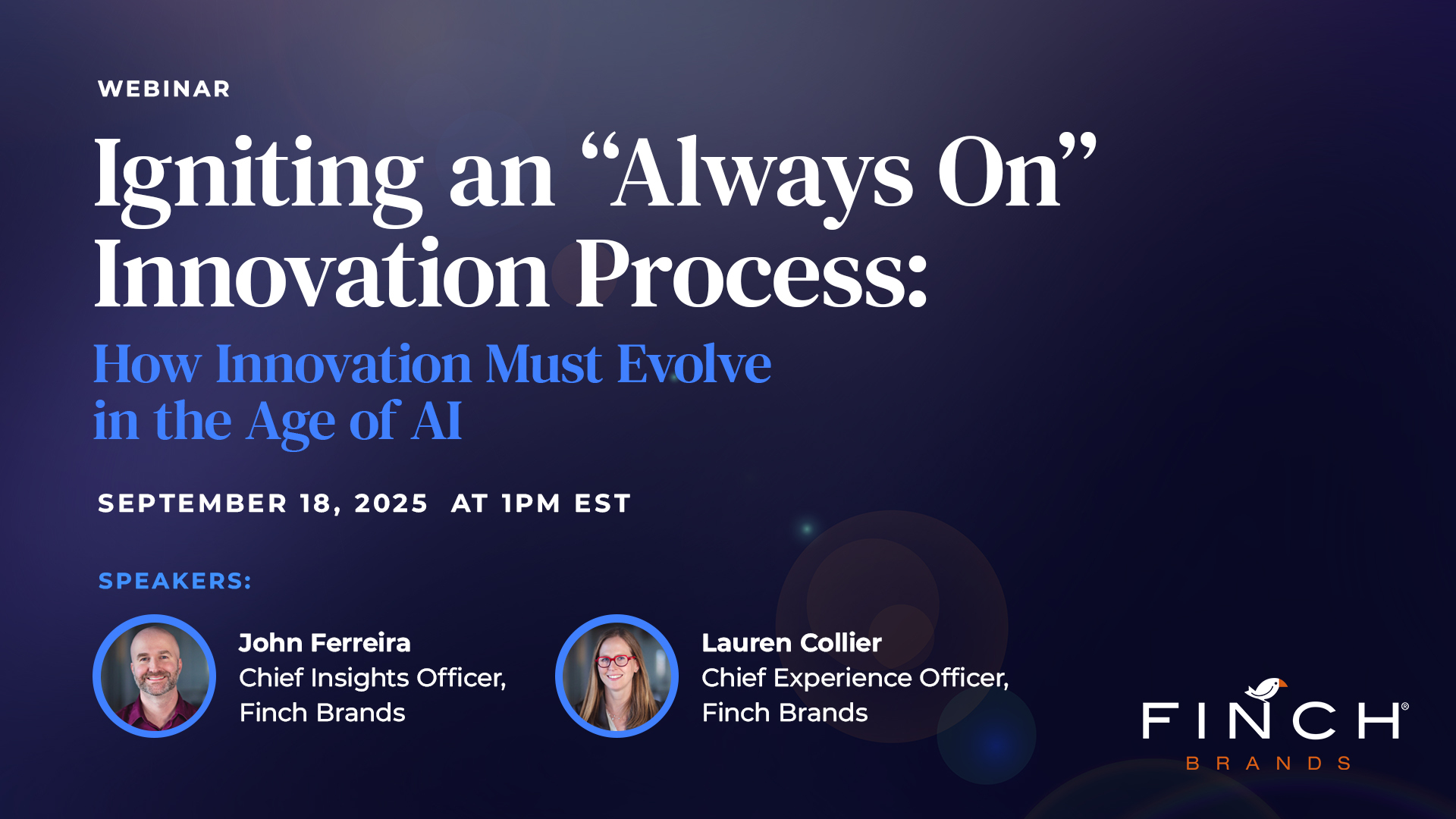
In this webinar, Finch Brands’ Chief Insights Officer John Ferreira and Chief Experience Officer Lauren Collier explore how innovation leaders can thrive in a world where customer needs are changing up to 50 times faster than before. Drawing on their experiences on the client-side, Finch developed an AI-powered platform, Charlie, that enables organizations to move beyond episodic projects toward an always-on model of innovation. This session highlights why speed alone isn’t enough — success requires “smart acceleration” fueled by continuous insights, cross-functional collaboration, and AI support.
[Lauren Collier]
We are live.
[John Ferreira]
Hey everybody, welcome to Igniting an Always-On AI Innovation Process presented by Finch Brands. This is our second in a series of AI talks this week, or actually within two weeks, where we’re bringing you insights, learnings, and sharing some news about new tools that we believe can really be game changers for helping you to solve timeless problems as well as create new possibilities. Today’s focus is about innovation.
So if you are an innovator in any way, shape, or form, you’re in the right place. And my name is John Ferreira. I lead Insights at Finch.
I’ve been with Finch for about a dozen years. Prior to joining Finch, I worked at Campbell Soup Company in an array of different roles, brand management, insights, and innovation. And I am co-presenting today with our resident innovation expert, Lauren Collier.
[Lauren Collier]
Hi everybody, I am Lauren Collier, the Chief Experience Officer. Been with Finch eight years. And prior to Finch, I was at Kimberly-Clark for a decade, where I ultimately led global strategy and innovation for the Kleenex brand away from home.
And as John mentioned, today, we’re here to talk about the importance of igniting an always-on innovation process and how we need to make sure we can’t just have speed for speed’s sake, but have smart acceleration within that process. But before we jump in, just a little bit about who Finch is. For those who don’t know us, Finch Brands is a real-world, insights-driven brand consultancy.
Research and insights are really at the center of everything we do, and we’re proud to draw on the experience of our senior leaders at places like Campbell’s and Kimberly-Clark, Subway, Ikea, Mars, amongst many others. And really, together, we built the firm that we always wish we had when we were in those operating roles. And when you think about who we are, our endeavor is to help brands win when it matters most, and we have been fortunate to work with clients such as these amazing brands on the screen.
We are always thinking about how insights teams and the role of those insights teams capturing, managing, filtering insights evolves over time within our offering. And insights being at the center of our 360-degree approach to real-world brand consulting, we start with the everyday moments. And what we do for hard, broad-shouldered moments, ongoing data collection and analysis as needed so our adaptive insights communities are there for the day in and day out, really is an always-on connection to the target audiences.
We have always offered custom research solutions at big moments when we have key decision points or ongoing work with new product launches or new audience segments, we have qual with quant, online, offline, traditional, progressive, our custom work really expands the full range. But today we’re here to talk about Charlie. Charlie is really about the today and the tomorrow.
We use an AI-powered platform, which we have co-created to help insights and innovation teams think about long-term trends, trajectory topics, and accelerated innovation platforms. This is all happening against the backdrop of significant change in our industry where customer needs are now changing up to 50 times faster. What is driving the change in part is acceleration of decision-making and innovation cycles.
What we know is we have some clients for whom product development used to be 18 months and now it’s 12 to 18 days. No category is immune to accelerating change. Even slower categories are not immune.
Everyone is faced with challenger brands and the need to defend against them in faster ways. Everyone is moving faster. Technology is creating the opportunity to do that and consumers are really demanding it.
When we think about this demand, we have found that many of our insights and innovation clients are challenged by the need for acceleration, but speed for speed’s sake isn’t going to do it. We really have to have smart speed. And if you wanna see results in the real world, must adapt both how you innovate and what you’re innovating.
Moving faster is not enough. So we have five principles of innovation and we need internal innovation adaptation to succeed with the external innovation. So our first one is thinking about being a one-time project where you’re starting from scratch to this always on innovation mindset and process.
And this allows us to have cumulative knowledge. It allows us to be adaptive, continuous and divergent innovation versus the linear and episodic innovation where you have to strike up the band every single time. The second one is going from inside out thinking to outside in thinking.
This is going from what can we make to what should we make? What are the needs of our consumers? The unmet needs and pain points as a point of departure as opposed to just saying, here’s what we should do.
If we really solve and adapt to solving these actual pain points, it should increase user satisfaction. It should increase loyalty. It should increase retention and ultimately deliver greater differentiation and long-term value creation.
Our third principle, going from siloed to cross-functional. We need to make sure the process is just as important as the content and that key people are brought in internally so that we are working the plan while planning the work. This is key so that everybody’s bought in and that everybody’s working towards the same goal and that we’re having this cross-collaboration and planning rather than working with disconnected departments.
Our fourth principle, narrow product focus to holistic product experience. We have the opportunity to think about the ultimate experience from start to finish and the small moments in between when it comes to innovation. And if we only think about product, we’re not thinking about innovation across the entire interaction a consumer may have with us.
So as we think about innovation, broaden our horizons across the entire journey for a consumer. And lastly, we want to shift from human-only to human and AI. And this is really key because we’re leveraging past learnings, we’re amplifying innovation, and we’re able to accelerate and broaden our reach across the board because AI is the ultimate catalyst to bring adaptation to innovation.
And we are developing this new AI tool that allows organization to make these necessary shifts along these five areas. And we’re keeping trends on your radar, we’re going deeper, we’re probing into jobs to be done faster, and we’re mapping to pain points smarter. So introducing Charlie, this is our always-on partner to understand both the today and tomorrow, and it’s going to allow us to make the necessary shift in these five areas.
[John Ferreira]
Great, well, thank you for that setup. I’ll see, I’ll go a little bit deeper here into how Charlie is designed to help innovation teams and insights partners really rise to that occasion, meet that five to 50X pace of change, where change that used to take five years to unfold in some cases can unfold in a single year. So Charlie really is intended to be the engine for innovation adaptation, to be able to take what works today and continue that, but also amplify what you’re doing, speed it up and increase the scale without injecting new work into the system.
So at its core, Charlie’s combining two worlds. One is proprietary insights. We know a lot of innovation teams that use ChatGPT and use Cloud and other tools, and that’s great that they’re running experiments around how AI can help them make iterative improvements in their innovation processes.
The one big downside of those tools is everybody has access to them. There’s nothing proprietary about it. And without sort of proprietary insights or proprietary process, there is no competitive advantage.
Larger organizations are fielding hundreds of thousands, in some cases, millions of dollars of research every year to collect those proprietary insights and give you your own unique advantage versus the competition. And that’s central and essential to a breakthrough innovation process. It’s very hard to do that with ChatGPT and Cloud, which are public tools, just like Google has been a public tool for decades.
At the same time, there is a tremendous amount of value in data and insights that exist in the public sphere. And we’ve never found a great tool for taking those insights and making them actionable. So things like, what are people saying on TikTok?
What are the conversations going on on Reddit? People who are deeply embedded in a category with a brand who are writing blogs. What are they saying?
What’s the pulse in the media? What’s going on with competition? What about product reviews?
There’s this treasure trove of attitudinal, behavioral, ethnographic insight that’s out there. And it’s always been sort of just out of reach. So Charlie takes both of those worlds, brings them together and allows always on analysis for always on innovation.
So at its core, Charlie connects the dots. It connects anything you’ve ever learned about any topic. So that way you’re not creating everything from scratch every time you strike up your innovation process, along with anything that’s visible in the public sphere across the web.
Then Charlie allows you to see what’s next for trend identification. And actually you being able to train Charlie on what you specifically care about as an individual based on the brands you work on, whatever the new priority is that hit yesterday. Charlie can be your extra set of always on eyes and ears to scan the environment for what’s that next trend?
Where do we wanna make that big bet? What is it? What’s this new move that the competition just made?
And then the third part is around creating the future. So when you have that really rock solid contemporary insights foundation that’s constantly changing, taking it from like a photograph to a moving picture, like a movie, doing something about it. Actually having a partner to co-create ideas at scale and turn them into testable assets.
That’s what Charlie’s designed to do. And here’s what it looks like. Lots of different features here.
At its core is chat. If you need an answer, you can ask Charlie for its perspective on that. And it will instantly scan your full library of internal knowledge as well as any external knowledge that may be relevant to answering that question and give you quick perspective.
That’s incredibly valuable for innovation and sort of doing a bit of that investigation, sort of peeling the story back a layer at a time. Chat is terrific at that. There’s also a deep analysis feature which allows you to create from simple to robust reports on really any topic that you would want.
You can explore consumer or customer demographic. You can explore particular trends and topics and competitive innovations and what’s going on in Europe versus in the United States. What are trends that are emerging in Japan, for example, that we can borrow and cross over into the US.
So the deep analysis is a really valuable tool for once you kind of find a topic area you’re interested in, you can go that level, that much deeper. Persona conversations are a way to bring your target audience to life in a very real way as a sounding board. So as you’re exploring ideas, you can explore them or get reactions to those ideas from simulations of your target market.
So we can train Charlie on your segmentation. We can train it on the reports from the segmentation, the raw data from the segmentation, typing tools, and then Charlie will very faithfully play back the perspectives of those segments. And you can ask them, you can even talk about what they care about now.
You can bounce product ideas off of them. You can even talk with them about things that are changing and how are they likely to adapt to that? And how are they likely to evolve over the next six months or a year or whatever that might be.
Innovation Image Lab is another feature designed specifically for innovation teams. So that’s where all the ideas that you generate with Charlie for chat, for co-creation, you can bring them to life as packaging renderings, as mock advertisements. And these are images that you can generate at scale.
So not just one image at a time, even multiples at a time, choose which one you like the most. There’s an image editor as well, where you can, if there’s an image you like, you can tweak it. And this is all within brand standards for a high degree of consistency from image to image.
So that way they are consistent testable assets. Recent workspaces are a place where innovation teams can accumulate knowledge and get work done. If you have a special, let’s say you’re working across three different innovation projects or three different brands, whatever it might be.
You can create separate innovation workspaces, collect your chats, collect your reports, and have it be more than just a disposable exercise with a chat chippity or a clod. And you just sort of forget you even had that chat, but you can really chip away at knowledge to iterate through your always-on year-round innovation. Stories is a terrific feature.
That’s where the always-on really comes to life. And that’s where you can tell Charlie what you care about and set up automation. So I care about Gen Z coffee trends, or I care about how inflation is affecting people’s iPhone purchases, whatever it might be.
You can point Charlie out for these particular, in these particular topic areas, and Charlie will scan your internal knowledge, it’ll scan your external knowledge, it’ll look for changes, it’ll look for news, it’ll spot trends and patterns, and it’ll bring it back to you in the form of these sort of bite-sized stories that you can then chat with and go deeper on. And then the longer Charlie’s running, it builds up this whole library of stories, which actually expands your knowledge base. So it’s not just the reports that you plug in here, but it’s, Charlie will, it is a knowledge builder over time, which helps to fuel that proprietary advantage.
So starting with connecting the dots, Charlie at its core is a really powerful knowledge management platform, which is a great foundation for innovation. So connecting all the internal data that you care about, your quant studies, your qual studies, syndicated reports that you may have, strategy decks for context, you can plug operating plans in here, and it goes beyond reports too. I mean, insights, I think most innovation teams are not looking for insights and trends within call center data, for example, but there’s all sorts of customer complaints and praise are a valuable source to look for in terms of pain points or things that are really delighting, delighting your target consumer.
Externally, there is all the value in the data we talked about, TikTok, Reddit, Facebook groups, wherever it may be across social data blogs. Many industries have a whole collection of different industry websites that are constantly publishing free information, and it’s hard to wrangle or even know what’s new out there. Charlie makes that process easier.
Product reviews, we have clients where we’ve analyzed tens of thousands of product reviews to sort of find all the signals in the noise, figure out what it means, where are the key pain points, where are the trends, what’s working, what’s not. App store reviews, thousands of websites. So there’s so much value in connecting the external data too.
And then a really nice bridge here is insights community data. So if you have a knowledge management system, it’s only as good as the knowledge that you have in it. And if the marketplace is moving at five to 50 times faster than it used to, you better have a steady stream of fresh research that’s keeping your picture of what consumers and customers care about contemporary.
Insights communities is an always-on year-round window into what your consumers or customers feel about really any topic or a terrific companion for a system like Charlie and terrific fuel for innovation that you can look for inspiration and see what’s changing all year round, but you can also then test those ideas all year round. And hopefully this always-on piece and the importance of it is coming through. It’s not just an annual process where you want to be testing, exploring consumer customer needs once a year and then testing once a year.
That’s in almost any industry that’s really not, that formula doesn’t work anymore. So whether it’s quarterly, whether it’s monthly, whether it’s sort of chipping away at a piece of time week by week, communities and Charlie pair really well together towards that end. So here’s an example.
What do we know about Gen Z and cold brew? So I put that question in. I got a nice summary from Charlie across a number of different studies.
It’s linking back to the sources, not only the sources, but the specific places, but it’s finding two studies. So our knowledge in this area is fairly shallow. So then I asked Charlie, what else can we learn from across the web about this particular topic?
And it’s finding really valuable industry trade publication research. That’s a bullseye, exactly what I’m looking for. And it’s instantly expanding my knowledge with four other credible sources.
And I can go source by source to determine, do I trust them? Then I can go and I can connect the dots further and expand my knowledge using deep analysis. So I ran a report on Gen Z and cold brew and we’re finding things like how this is the first generation that’s really drinking cold brew year round.
And it’s sort of this, it’s a lifestyle thing. The cold brew is really the new cola. And there are these micro moments that really matter.
There’s a self-care component to cold brew. It’s sort of like treating yourself with a certain wellness halo to it. There’s social currency.
It’s cool to be seen with this beverage. And then Charlie is going out and it’s identifying off of our prompting jobs to be done. So there’s a refreshment and a hydration foundation.
There’s energy and focus is another key piece. There’s a social connection, self-expression. Cold brew allows you to kind of make it your own.
And that’s part of what Gen Z really values. And that’s part of what makes this beverage really special and why it’s skyrocketed in recent years. And then there’s this health and wellness halo.
And then we get drilled down into more of the specifics, what are trending ingredients that we should keep in mind within an innovation process? What do we have to keep in mind from a regulatory standpoint, which is sort of the want, want less fun part of innovation, but it’s good to know as you’re going through your exploratory process. And then we asked Charlie to start to create a first pass of some innovation territories that we might want to consider taking into a brainstorm.
So it’s generating some concept names, primary ingredients that could fit with it. What are the micro reward occasions and core flavor directions? And we’ll come back to this, but the post-workout recharge to us was something that really stood out because it makes sense across the needs of your heating up.
You want to be refreshed. You want to be recharged. You want to be rehydrated.
And what other needs might people have when they’re sort of in those moments? So that’s showing how Charlie can sort of help you connect the dots, but then also Charlie can help you see what’s next. So we mentioned the stories feature and the fact that Charlie can be an always on sort of investigator that you can turn on to keep you informed about most any topic or subject that you care about.
So here, coffee and wellness, something that I told Charlie that I care about, and it’s through the always on scanning, it’s finding this particular trend with 31 different sources and it’s creating a summary story to get it on my radar. I was sort of topically interested in this general area, but it’s not something that I knew enough to actually search for, whether in an internal system or even in Google across the web. So Charlie’s bringing all the inline sourcing and then it’s creating a summary table for this precision wellness trend that I discovered with Charlie.
What are the outcomes of functional ingredients and different scientific notes? And then you can talk to the story. So there’s this always on trend discovery component, but then I can go deeper and start to investigate right away.
So I asked, who are some of the early leaders when it comes to this particular trend? So now I can start to do some close in competitive intelligence with Charlie around these key players. I could ask for product images.
I could run reports just on those particular products. So that’s a way that Charlie can help you to spot trends. And then certainly, if you’re in charge of innovation, you want to keep tabs on what’s the competition doing.
So keeping track of challenger brands, for example, if you’re working at a brand leader, it’s something that’s really valuable. So in this case, I set Charlie to generate a report every six months on what are cold brew challenger brands? What are they up to?
This is a fast moving space. There’s lots of competition. It’s very crowded.
And I want to know who’s doing what. So Charlie can see scanning across the web, every brand that looks like it launched a product. Some of them have launched quite a few.
When did those launch? What are the key RTBs and proof points or claims that they have? Charlie’s making inferences around who does it appear they’re targeting based on things like the romance copy that they’re using in describing these products.
What’s the price point? Where were these products observed? So it’s a great way.
You can think of it as building your own custom personalized tracker. And you think about the power of trackers. What if you had a tracker that you could create that’s just for you, specifically laser targeted on a topic that you care about from an innovation perspective.
And then Charlie is also a great ideation partner. So actually, let me skip forward to this. Charlie, additionally, as far as trends and sort of insights, one key feature I did want to bring forth is we call it product hub.
And this is where we can point Charlie to different product reviews across the web. Charlie will instantly crawl across Amazon listings, for example, and allow you to see what’s working and what’s not across different products. And not only what’s working and what’s not, but why.
So we can see which products are trending up, which ones are trending down. Why are the top products performing so well? What are people saying about them?
And even you can set up trackers. So innovation teams, as you launch products, you also want to know not only the theory that led up to the launch, but post-launch, how’s it doing? Is this something that we should pour some fuel on the fire for?
Should we sort of grow this new innovation platform? Wouldn’t it be nice if you could track in real time, day by day, what are people actually saying about this cluster of five products that you launched around a new need state or toward a new target demographic or whatever it might be? Track the trends of where the reviews are headed.
See, do you have a home run or is this not likely to be sticking around in the marketplace and know that early? So you can either add that fast power product or kind of shut it down. And then the creation piece, Charlie can be a co-creation partner as well.
So we don’t recommend AI replacing the human element. We recommend it complementing the human element. So here is a list of ideas across mood enhancement and micro awards that a deep analysis report indicated were important to Gen Z when it comes to cold brew.
And Charlie was helping us generate an initial list of ideas. And then we went deeper into that the workout aspect of cold brew. And Charlie had surfaced a pre-workout or a post-workout.
And we added a pre-workout ideation here too. We have a range of different ideas. And then I grabbed one of them and I asked Charlie to create an image in an RTD carton with a screw cap and put a 10 grams of protein claim on it.
So Charlie is now taking what was an insight and became an idea. And now it’s creating it and turning it into a testable asset. This end-to-end chain could happen in minutes and you can do it at scale.
So one of the things that we know from third-party research conducted at the University of Stanford is that the number one most correlated element of any innovation program’s success with sustained innovation success in the marketplace, products that persist and are there for multiple years is the number of ideas tested in the funnel, the number of ideas that sort of enter that funnel at the high end.
And on average, for every sustained innovation success, it takes 2000 ideas, believe it or not. That seems overwhelming, but not that everybody needs to get to that level, but you need to not just be testing five or 10 ideas and feeling like that’s a lot. You need to find a needle in a haystack.
You need a big stack of hay. That’s what I like to say. So closing it out, Charlie is really designed to empower innovation teams, connecting the dots across your internal and external data, seeing what’s next.
The stories are your extra set of eyes and ears to proactively bring insights to you. The deep analysis allows you to go deep in wherever you spot those opportunities and then creating the future. Charlie is a co-creation partner.
That could be as an army of one. It could be bringing Charlie into a cross-functional ideation session to make it interactive and make it engaging. And everybody has sort of that AI assistant with them.
And then being able to generate images right there on the fly and drop them into something like an insights community to test your ideas at scale. So obviously lots of innovation applications, but also the foundational blocks that lead to innovation, category insights, exploration, targeting and understanding them deeply, exploring positioning spaces, all the different innovation applications that we talked about. And then even with your partner sort of crossing the finish line with how should communication come to life to maximize the chance of success for innovation.
A lot of these things are valued by other teams. So while Charlie is designed to be a home run for innovation teams, you’re not in it alone. And a tool like Charlie could be deployed across insights teams, across marketing to really get the most value out of it.
So that’s our talk. And we’d love to open it up to questions.
[Lauren Collier]
It looks like we have one question submitted here. You show that customer needs are changing up to 50 times faster than before. How can innovation teams realistically keep up without burning out?
I’ll take the first stab, John. The key is getting closer to your audience in an always on customer sensing way. And a couple of ways that we’ve talked about doing that, number one, insights communities, no more one offs, so that you’re constantly picking up signals, don’t need to re-recruit every single time.
So the adaptive insights communities that John mentioned is a great way to keep a constant pulse. The other great way is Charlie having AI trend scanning to help monitor forums, reviews, social platforms, and spotting those emerging needs. The idea is to always have a pulse on everything and then you get to pick up on those signals.
And then the third space is really rapid experimentation and prototyping. No need to test all these concepts over the course of months. You can test them in a matter of hours and days, and you can do this with all the ideas and concepts generated in AI, as well as with mock-ups and minimal viable products to generate a lot of ideas and bringing cross-functional teams together to be part of that experimentation and prototyping along with your consumers in a way that ensures decisions are also moving at the speed of change because you have all the right people in the room, but ultimately making sure, and by the way, we call rapid experimentation a bounce and build process here at Finch, and we can share more about that. But ultimately, the best way to make sure you don’t burn out is to really drive and change the culture.
It’s a mindset shift. This is making sure the internal is changing along with the external. So if we can change the culture mindset, then we are always on and that this is ingrained in who we are, so that speed becomes inevitable and becomes part of the process and it becomes less of a burnout.
John, anything to add to that answer?
[John Ferreira]
Yeah, I just would add using AI done right, it’s working smarter, not harder. You’re not actually, in fact, you’re likely saving a lot of time in your workflows versus this being like, how am I going to possibly fit this in my schedule? Like this, you think about how much time this could save you on trend identifications than contemporary, like it’s designed to be a time saver to create space for your work on those things that matter most.
That’s probably the one thing I would add.
[Lauren Collier]
Yeah, great question from Rachel. What might you have in place for assurances of protecting assets and trade secrets for brands in highly regulated spaces? John, I’ll let you pick up.
[John Ferreira]
Yeah, so the technology platform here is very purposely built so that public information comes in, but private information does not go out. So nothing you ever enter into Charlie ever trains any of the models underneath the hood. And I’ll share, Charlie is actually built on more than one LLM.
They check each other’s work to reduce hallucinations and increase the quality of responses. But in no way, shape or form does your data ever leave your organization to go and do anything anywhere else. You’re not even training Charlie.
And then within things like insights community. So if you’re using an insights community to test the ideas, there are things like watermarking of stimuli that we can do invisibly to the respondent to be able to trace back to individual stimuli that serve individual respondents to be able to sort of create that, create that audit trail.
[Lauren Collier]
Another question. How does Charlie avoid just giving the same answers as chat GPT and actually create a competitive advantage?
[John Ferreira]
Yeah, a couple. Well, one would be the point I just talked about. This is, it’s not just putting all your chips into one large language.
It’s Charlie’s built on a collection of them. It’s meant to take, give you the best of the best for all the different use cases and the capabilities that are plugged into the tool. Not every LLM is the best at everything.
So our tech team is constantly changing how Charlie works under the hood to stay in tune with where AI is today because it’s changing every year, every month, every week, in some cases, it feels like. So that would be a big piece of it. And then your internal knowledge, chat GPT.
Yeah, you can upload a couple of reports here and there, but that’s pretty different from having access to anything you’ve ever learned about any topic. And that being a source of proprietary advantage that anybody else using a chat GPT is not going to have visibility into that. So you’ll get better answers if it’s topics you care about that are relevant to your knowledge estate.
[Lauren Collier]
One more here. How do you balance traditional research projects with an always on rhythm of innovation?
[John Ferreira]
You want to tackle that one? Or I can.
[Lauren Collier]
Why don’t you start?
[John Ferreira]
So, you know, traditional research projects is always on innovation. You know, you can think about that as. A lot of the upper funnel, a lot of the mid funnel, seeing and spotting more trends to make smarter decisions.
There’s just so much noise in the marketplace. Like, where are the signals? Charlie is meant to help you find the signals, and then you can test those ideas at scale.
So something like an insights community, we have almost like a modern dating app, a swipe right style tool where it’s just very easy on the respondent. They don’t need to do a lot of cognitive processing. They see an image of a product, for example, like they would on a shelf and they react to it.
And are they interested or are they not quick snap judgment? We can filter down through 100 ideas and have results, you know, within within a couple of days in an insights community. So you get the speed to the insights with that always on piece.
And then, you know, the richer, deeper research projects of traditional research and really taking the time to do that well, right? You know that there’s still a place for that as you narrow the funnel and you figure out, you know, where do I really want to make my big bets? Where do I want to do that additional due diligence?
And I’ll say part of the part of what makes the process better is also if you’ve done real world quality and you’ve done ethnographies and you’ve done all this immersive research, we see so many innovation teams, it’s almost like they flush it every time people rotate or people forget about those studies even existing. If they’re in your knowledge library, those traditional research projects are going to make your always on innovation process that much stronger because you’re going to always be standing on the shoulders of that institutional knowledge. So that would be sort of another way that it all connects.
[Lauren Collier]
One, two builds. One, the cross-functional piece. I think, you know, innovation needs to be shared across all of the functions.
It can’t just live with the insights team. So innovation needs to think about, you know, who’s going to activate it so that everybody’s involved and we can accelerate decision making and getting all the right internal team members aligned. And secondly, it comes back to that mindset.
If the entire organization and the culture is thinking about innovation as an always on mindset, it’s there to answer both the today and the tomorrow and not just be a one-off, one-time research project. It really should be always on. Great.
So that concludes our questions. Thank you all for joining us today.
[John Ferreira]
Thank you much.