Webinar Replay – Escaping the Research Grind
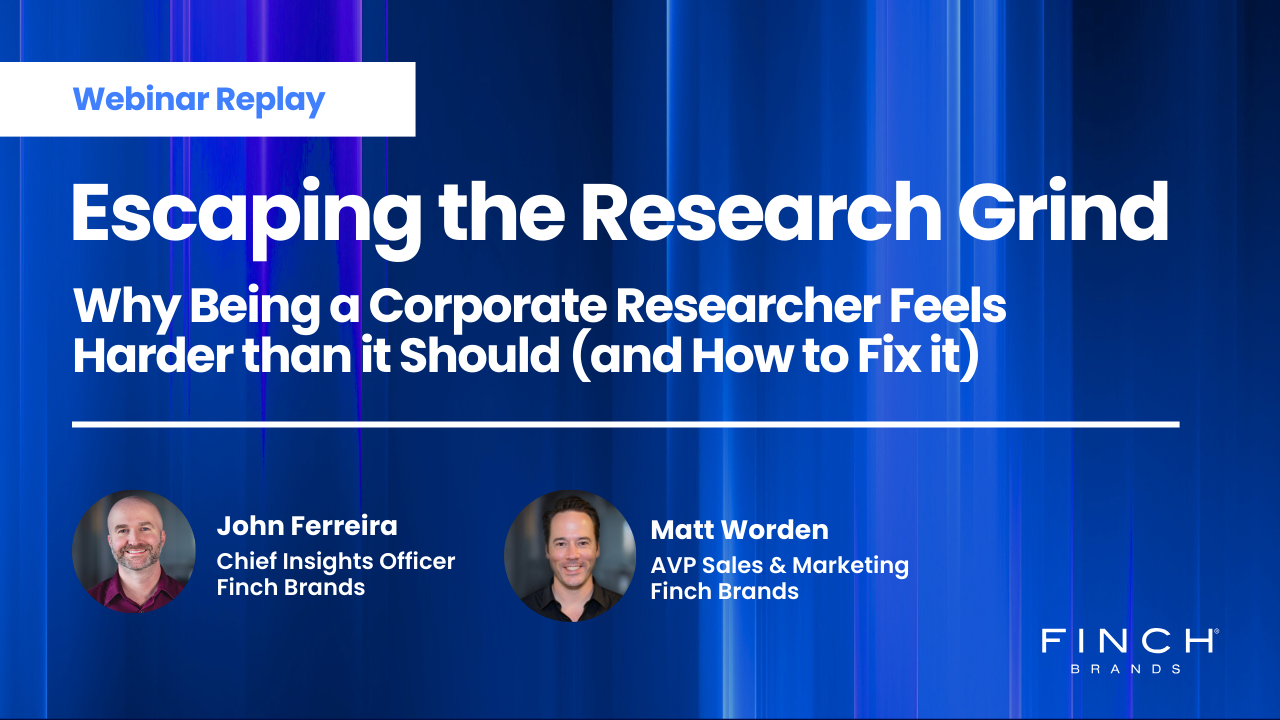
Why Being a Corporate Researcher Feels Harder Than It Should (And How to Fix it)
Corporate research wasn’t meant to feel like an endless scavenger hunt—but for many teams in 2026, that’s exactly what it’s become. Between deck digging, fire drills, and recreating work that already exists, researchers are spending more time searching than thinking.
In this webinar, Matt Worden and John Ferreira of Finch Brands unpack why the research function feels harder than it should—and what it takes to fix it.
Drawing from firsthand experience on both the client and consultancy sides, they explore how low-value work is keeping insights teams stuck in the past, and why freeing up time for synthesis, foresight, and influence has never been more critical.
You’ll see real-world examples of how teams are escaping the research grind, reclaiming hours each week, and stepping back into their rightful role as strategic partners to the business.
This session will cover:
- How to free up your time for strategic work by reducing “busy work”
- How to increase research return on investment (ROI) and your return on effort (ROE)
- How to turn insight into influence in your organization
Escaping the Research Grind in 2026 Why Being a Corporate Researcher Feels Harder Than It Should (And How to Fix it)
[Matt Worden]
I’m excited to talk to you today about escaping the research grind and why being a corporate researcher feels harder than it should and how to fix it. I’m Matt Worden, I’m joined by John Ferreira. We’ll go through intros in just a second.
I did want to provide the perspective on, you know, where this perspective is coming from. So, just a little bit about Finch before we get started. Our vision here was to create the firm we couldn’t find when we were in your shoes.
We were the clients. A real-world, insights-driven brand consultancy—It’s really who we are, it’s how we think, and it’s what we do.
We help clients in the moments that matter most through insights, through brand strategy and design, all in one house. We’re thought partners. Clients tell us we’re curious and high energy.
We’re deeply focused on outcomes, and we bring a high “get-it factor” every day. Today, we’ll be talking a lot about a solution called Charlie by Finch Brands™️ but understand there’s a lot more to Finch from insights communities to customer journeys, to innovation methodologies, to even developing brand architecture. So, just know this is one perspective.
We, of course, bring many to the table. Joining me today, as I said, is John Ferreira and I’ll just share a moment about me and then John will intro himself and then we’ll start to really tackle this topic. My name is Matt Worden and, as I said, I lead sales and marketing here at Finch.
I started in the trenches as a researcher with Harris Interactive back in the day. My clients back then were Microsoft and Nokia and, well, Nextel, so that will tell you how long ago that was. From there, I have really taken my perspective, my research perspective to other companies and just had an interest in connecting folks like yourselves with great companies like Finch.
I met John at a trade show. We started talking and, John, we haven’t stopped talking since. So, why don’t you introduce yourself and we’ll start to tackle the subject.
[John Ferreira]
So, John Ferreira, I lead insights at Finch. I’ve been with Finch for a dozen years. Prior to Finch Brands, I was at Campbell’s Soup Company in a mix of brand management and insights roles.
So, I’ve been in a chair very similar to yours and I’ve also been that internal stakeholder with the impossible demands. So, I kind of have both sides of the coin there. But let’s dive into it.
Market research is at an interesting point. It’s amazing how much time market researchers spend on low-value tasks. And I think, you know, this quote is a little bit lighthearted, but this isn’t the way market research plays out within corporate research.
It isn’t what we really signed up for. It’s not why we got into market research. It wasn’t to dig through dozens of backward-looking decks and try and piece together answers from things we already know when a new stakeholder comes into play and they’re starting fresh.
We got into it to uncover consumer truths, customer truths, shape strategy, drive innovation. Somewhere along the way, it became less about thinking and more about searching, less about strategy and more about scrambling. So, that’s not really why any of us got into this field.
And that’s part of what we’re trying to fix at Finch Brands. And the numbers back it up. So, triangulating across a handful of different studies in this area, 8 to 12 hours a week are lost searching for information or recreating work.
That’s a full day. That’s at least a day. That could be a day, day and a half.
Some weeks it might be two days where you’re just digging. You’re digging through decks, you’re assembling answers to backward-looking questions for existing stakeholders, new stakeholders, rolling through SharePoint, digging through emails, trying to find all research studies, working through 10 decks to find those five slides that matter. And that’s not strategic work.
That’s busy work. That’s not what feels good. It’s not what feels rewarding.
It’s not what makes a difference to the company and it’s not what advances you in your career. So, that’s, from our perspective, a real problem systemically across corporate research. And it’s got to change because that’s how researchers get stuck in the past, answering old questions, repeating yesterday’s work.
We’re not archaeologists. We’re much more of what the company needs from us. And what we really enjoy most is looking into what’s next and focusing on the future.
And every hour spent mining the past is an hour that’s not spent influencing that future. That has real consequences and implications for your career and for the organization that you work at. That’s what causes researchers to be on the outside looking in, in many cases.
When I was at Campbell and a researcher, the thing we would always talk about and the thing we would chase was making sure you had a seat at the table with whoever the new GM is or whoever the new VP is. We wanted to move upstream. We wanted to be focused on the strategy and really be seen as the most valuable and consequential partners that they worked with within the organization.
So, that was the fight every day. And today, Insights doesn’t just deserve a seat at the table. It’s essential because the marketplace is only speeding up.
Research that we have shows that consumer and customer trends are changing somewhere between five and 50 times faster than they used to 20 years ago. And the only way the organization is going to be able to make smart decisions on these timetables is if really researchers are freed up from the low value tasks and can really get into that room and have that seat at the table. So, how do we shift from spending our time mining to meaning?
And that’s really about this new sort of paradigm, this new view of how do we take this busy workout, how do we create the time and the space to think? How do we get you unstuck so you can spend time synthesizing, spotting emerging trends, walking into leadership meetings with a stronger point of view? And you can’t do that when you’re spending, you know, multiple days a week in reactive mode.
So, breaking free from the research grind, you know, isn’t about doing more with less. Everybody seems to be asking researchers to do more with less with each passing year that goes by. And that’s not what this is about.
This is doing less to unlock more. And that might sound like it’s too good to be true. But I’m going to show you some concrete examples of how some of our clients at Finch Brands are partnering with Finch to be able to do that, to unlock that time and to make more of a contribution to the strategy that their organizations matter more.
So, what is the less here? It’s about less busy work and more valuable work. It’s about less deck digging and more big thinking.
It’s about less hindsight and more foresight, less reproving prior findings, more driving impact, and less fire drills, if you’d all agree on that, and more influence. Think about what it feels like when you spend so much of your week stuck on the left-hand side here. If we can reduce that to create more time and space for all the stuff on the right, that’s where you’re fully activated, not just you, but your co-workers, your entire function, and you can really energize your organization.
So, Finch Brands has spent quite a bit of time working with a technology partner to create a solution that allows organizations to get from that less to that more. And we call it Charlie. And Charlie is a knowledge management tool that’s designed to elevate insights, give you your time back, and unlock your potential.
So, it takes knowledge management and takes it to that next level. We call it knowledge empowerment. So, how does it do that?
Well, it starts with connecting everything you wish you knew with everything you know, with everything you wish you knew. So, the two sides of the coin. So, what do you know?
You have quant studies, qual studies, syndicated reports, strategy decks. You might even have structured data sets from call center or e-commerce. And then there are all these other sources that researchers either often don’t think to look to, or you don’t have the right tools to look to for answers.
So, what’s going on with Think Talk about on TikTok or Reddit right now? There are a million social listening tools. I haven’t found any of them to be any good, and they’re not very good at finding specific answers to specific questions.
Conversation on blogs, fast-moving news on industry websites, product reviews are a very rich set of ethnographic data. There’s all this data. And what if we can combine all this into a holistic perspective in one system?
So, that’s what we built. Having the depth of knowledge inside your org and a rich breadth of insights from outside your org. So, a quick twirl on Charlie, then we’ll show you some live examples.
Starts with chat. So, when you connect anything that you’ve learned about any topic, it’s instantly accessible within chat. Deep analysis allows you to create structured research reports where you tell Charlie what their goals are, and it will automatically generate reports on these topics for you.
In many cases, looking at hundreds or even thousands of sources, which blows away the breadth and the depth you would ever find from a free tool like ChatGPT or Copilot or any of those tools. Persona conversations. We can use your data and external data to train up personas where you can then have live conversations with a voice that would represent thousands of consumers within an individual segment.
If you have a segmentation, we can train it on that. If you don’t, we can spin up segments on the fly looking at things like social data. That’s great for concept testing and sort of pressure testing upstream questions.
There’s an innovation image lab to bring ideas to life. Innovation teams love this, and it’s a great way to tighten the relationship between insights and innovation. And then we have workspaces or projects where you can collect your thoughts and sort of get active things done.
And proactive stories is neat. We can set up automations. I’m going to show you how.
Or you can tell Charlie what you care about, and Charlie will be your extra set of eyes and ears to keep you on the cutting edge, finger on the pulse of the topics that matter most to you and the topics that matter most to your stakeholders. So that way, thought leadership really shines through the insights function. So with that as an intro, we’re going to take you through some real-life scenarios, most of which, maybe all of which you’ve probably lived through yourself, that seem like impossible situations, but Charlie is designed to help you thrive in these moments.
So first, we’ll call it the 4 p.m. fire drill. Do we know anything about what Gen Z thinks about our branded merch? I need it today by 4 p.m. So huge request. That could easily blow up your day. That could easily kind of sideline you from bigger priorities. And it’s not a simple request.
How many different decks, how many different studies are you going to have to mine through to find the few slides that matter? So, here’s how we would do it in Charlie. So here’s the homepage.
You have all the different ways that you can interact with Charlie, creating projects, searching. There’s stories function we’ll talk through, but let’s dive right into one of these project workspaces. So it’s as simple as asking that very question to Charlie.
What do we know about Gen Z attitudes towards Starbucks merch from past studies? And it’s assembling off four different studies. We have a simple summary of overall sentiment, key Gen Z behaviors and preferences.
And we find things like cups and tumblers being particularly trendy right now. I just clicked on an individual page in an individual document that Charlie sent me to. So I get a quick summary of what we know.
And then the four different files have 10 different pages. Imagine how long it would have taken to find the 10 slides or 10 pages that matter most out of all those decks after I even found what the right decks were. Then I instantly expanded on our knowledge, asking with the same question, what else can we see externally?
Charlie’s finding a very case study. It’s finding a little treats culture principle from psychology around how Gen Z thinks about these things and how they are going through their own hero’s journey of social validation and mini indulgence. So, moving away from luxury goods into these being important roles in their lives.
There are additional stats on Gen Z brand of merch and how brands can deliver. So, what are the product categories that matter most? What are the critical requirements, preferred distribution channels?
We’re getting this rich treasure trove of information that’s out there, but it’s just a little bit out of reach with any other tool that we’ve seen. Strategic implications, what’s working, what needs addressing, questions to consider. So, Charlie’s not just bringing the insights, it’s bringing a connection to strategy.
It’s even looking across Google trends data. And then here I must create a presentation around the key findings, the ones that are most important. And then boom, Gen Z and Starbucks merch, stakeholder questions, stakeholder answers, simple executive summary, case study on the very stick phenomenon, those psychology principles I mentioned, including the emotional journeys and the uproar of emotion, social media amplification, all the things that matter most from this report turned into a deliverable.
I didn’t even touch this. I didn’t format this at all. This is ready and sendable to my stakeholder.
So, imagine how much time that would save you. That just saved your day. I did that in Charlie in about 15 minutes instead of four or five hours it would have taken you.
Next up, the casual emergency. We’re getting pushback on our strategy. Can we field some focus groups in the next 48 hours?
I think we’ve all gotten this type of impossible request. Not only is it sort of a breakneck request, but it’s also the marketer comes in with the methodology in mind, which I know always frustrates researchers. So rather than a focus group, we can just use Charlie.
So I asked Charlie to help me create a prompt and had it run that prompt. It ran 29 actions and with the 47 sources and the policy in question here, Starbucks recently moved to handwritten messages on cups and the feedback internally you can imagine is maybe from operations on the field, they’re getting some pushback. So Charlie’s going out and it’s looking across what are people baristas and consumers saying, and it’s finding this paradox of forced authenticity.
The baristas in many cases, three quarters of them in social conversations really don’t like the policy. There are sort of strict consequences to not following it. They feel like it’s inauthentic and it’s sort of forced.
Consumers, it’s a little bit of a different perspective, 40% positive, 25% negative. That’s still a high degree of negativity. They also feel like what was always something that was authentic is now can be inauthentic if it’s mandated.
There was a viral moment Charlie spotted where a barista wrote blah on a cup and the customer reacted to that. But here are all the critical themes, this paradox of forced authenticity, impossible choices. Charlie’s spotting friction within company strategy.
So there’s a four-minute service time requirement for delivering for each customer, but then you’re adding five to 15 seconds per cup and the baristas feel like at peak times, it’s just mission impossible. So, it’s really destroying morale. And Charlie’s picking up all this through real conversations out there in the real world.
It’s going through for strategic application implications. What are the critical risks and opportunities? What are some actionable recommendations?
So, it’s coming up with thought starters around ideas, for instance, create flexibility during peak time windows or link it to the loyalty app. It’s more personalized and generic and it’s sort of conditions trigger it. It’s creating a bottom line around what’s working and what’s not.
And then Charlie’s generating files you can use. This is downloadable into a Word doc right out of the tool. It’s going to summarize all the different findings.
All the raw results are here as well. Rich sets of barista and customer verbatims and also all sorts of other files here that can help you turn that insight into action. We have two more of these we’ll hit on quickly.
Next is the blind spot. And this is one that I have lived from so many times at Campbell’s Soup. I’m curious if you’ve lived it too.
[Matt Worden]
Our new product isn’t landing the way we expected. I wish I understood what’s really going on.
[John Ferreira]
Very common in organizations, understanding what’s really happening after you roll out a particular innovation. So here we’ll dive right into the project. And here it’s helped me create a prompt to diagnose why Starbucks Frappuccino Light is underperforming.
Use product reviews, social media posts from real people, not paid reviews. Charlie’s thinking through a structured prompt on how would I tackle this. And it’s all the different social media sites that you look at with different guidelines, making sure that they’re unpaid reviews.
It’s creating all that structure. Like we’re beyond the point where you need to be a prompting expert to get a lot of value out of these tools. All I said was run the prompt.
Three words. Charlie went through 23 actions. He looked at 25 different sources, product review sites, social media commentary, and created a really rich portrait of what’s working, if anything.
And in fact, most things are not working in this case. So it talks about there’s a 52% recommendation rate and a 3.25 to 3.95 star rating. That’s really bad.
You want to be at least at a 75% recommendation rating. Charlie actually taught me that. Here are all the issues with the product.
Labor dilution. There’s a discontinuance of a prior product where consumers felt this was a major downgrade. Huge quality control issues in terms of texture.
Artificial sweetener polarization. And there’s a value perception gap where there’s a little bit of shrinkflation going on when the older product was replaced with this one. So all these different, very specific findings that Charlie’s able to extract from insights even outside of our primary research.
And now it’s creating various different themes of what people are citing as issues or what they’re asking for. Low caffeine content is also an issue compared to what people would want for the job this is supposed to do. Charlie’s framing up the core problem and it’s even helping to come up again with starter recommendations of what might we do across the next 12 months and creating three different options to consider around aggressive focus or portfolio focus strategies.
It’s then going to turn all this into files. Again, Charlie’s intended to be to translate insights into action, things that you can edit as you see fit and send to stakeholders as quickly as possible. And again, think about how would you even have answered this question?
Would it have taken a ton of primary research, which would have taken up a lot of your time and probably also on a breakneck timeline and prevented you from focusing on other important things that wanted to play. And lastly, the FOMO moment. I don’t want to chase trends after they’re obvious.
I want to see what’s emerging while there’s still time to act. That’s sort of every CEO, every GM, every VP. Charlie can help with that too.
Charlie can be that extra set of eyes and ears to help insights leaders to really be seen as thought leaders within the organization and not just power doers. This upper right-hand portion of the screen is where stories are and stories here, I can personalize them down to me as an individual or set them at an organizational level. Emerging price and trends, category disruptors, what’s trending on social, track price value perceptions over time.
I can create one around anything I want across internal files, external files, do I want updates monthly, weekly? I could even have it track specific websites and specific trends that are popping up on a website that I like to follow often. And then it’s going to create this rich library of all these different studies that help you see a window into where things are headed.
For example, emerging coffee trends for Gen Z. And we’re finding an article here on adventurous flavor pairings. It’s looking at 368 sources.
There’s no other AI tool I’m aware of in the market that will go that broad or that deep. And it’s creating reasoning. There’s a confidence score around all the things that it’s finding, high, medium, low.
It’s uncovering texture, a spicy trend and how spicy is about to morph into “swavery”, which is sweet and savory and sweet and spicy. Charlie’s great for sort of keeping you on that cutting edge and having you help to lead the thinking within your organization as well. So how else can Charlie help to raise your game?
Well, really across the board, elevating insights into action. We talked about the instant deep knowledge. Today, we didn’t talk as much about generative co-creation, but you and your colleagues can co-create with Charlie, create new concept ideas, turn those into testable assets.
You can collaborate in projects. And then the decision ready outputs. Hopefully you saw that today between the presentations and the documents, trying to make, take even like deck creation and simplify that down.
So, your ideas can travel faster through the organization. That means less grind and more influence. That means the small wins compound.
You’re not going to have your calendar devoured by small daily tasks, onboarding new teammates, which happens all the time. Instead of months, what if that could be days? Saving hours on meeting prep and standing out in that meeting.
More effective research briefs. Every research brief started with, here’s what we know about this topic already. And that’s just to check the box, but it was a really good summary of what we actually know and what we need to then close knowledge gaps around.
Accelerating innovation, senior leadership, meeting prep, really the possibilities go on and on. And there are three different ways to activate Charlie. You can be hands-on with the tool, kind of like you saw me doing today.
Some of our clients don’t want to do that. They want Finch to operate it for them as experts. We’re happy to do that on a retainer basis.
And you can be in there. We can be in there at the same time as well. These partner really well with insights communities.
Increasingly our insights community clients are using this as a wraparound around the community because the two complement each other so well. And then project work. So for some clients, we’ve deployed Charlie for deep dive ethnography, patient journey work, helping to even supercharge in-person research by getting really smart on topics before we can get out in the field, bringing really rich personas to life, transporting.
Lots of ways where if you didn’t want to kind of go all in, but just wanted to kind of test Charlie out, project work is a great way for us to do that. Matt, if you want to kind of bring us home here.
[Matt Worden]
Sure. Yeah. And as I mentioned at the start, this is one perspective on one offering that we have at Finch.
The biggest thing that I couldn’t say enough about is that we built the firm that we wanted when we were clients. And that really is a combination of insight strategy and design, right? All under one house.
And so while I can certainly see this as just a laundry list of what we do, we really thrive in moments where people come to us and they have very unique challenges and, you know, because we have this breadth of services, we can provide unique, you know, really kind of groundbreaking solutions that will really allow them to get to the heart of the matter. And Charlie’s just a part of that. So, you know, if there’s something more than Charlie that you saw on the list and I realized it was perhaps a little bit small on your screens, let’s have a conversation, you know, if it’s worth just, you know, kind of spitballing and, you know, talking through what the challenges are, you know, we’re happy to have that conversation, you know, just to kind of give you an idea about our thinking.
So did have a couple questions come in. We certainly encourage more questions through the chat here. And the first one, Don, is we get this one a lot when we’re talking to people about Charlie and that is, you know, I have chat GPT.
I have, you know, whatever solution there is. How is this different? Why would I, you know, use Charlie?
[John Ferreira]
Yeah, the two, whether it’s chat GPT or Copilot, it’s really a complementary relationship. They might look the same in certain ways, but they’re fundamentally different. Charlie is specifically built for enterprise research grade work.
It’s meant to inform strategy decisions. It’s meant to make you make better decisions. Things like Copilot and chat GPT are designed for efficiency.
So within your existing workflows, cutting some work out of creating that presentation or whatever it might be, analyzing your emails, those types of things. This is about helping you create really smart perspectives on what you know and what else you can learn instantly on any given topic and framing it up in a way that’s professional and polished with researchers in mind and your stakeholders in mind and sort of strategy ready. So the amount of data you can connect to Charlie is far beyond what you can do with a chat GPT or a Copilot.
The way that Charlie processes and understands the relationships between all your files is a whole different level from either of those other tools and all the extensions that we talked about of how to really use this as an innovation tool and how to apply it and get value out of it. Charlie has various features that those solutions don’t and the list sort of grows every day. Charlie can even talk to your structured data sources now.
So if you wanted to connect those and have a live conversation, you can do that in Charlie and you’re not going to do that at an enterprise level on Copilot or chat GPT.
[Matt Worden]
Right, that makes sense. You know, thinking about how Charlie came to be, certainly with everything we do, we bring that real world experience and you know, brought, you know, what do kind of insights professionals need, you know, in the age of AI and brought that perspective when we, you know, thought about Charlie. Can we talk a little bit about what this means for the rest of the organization?
Like, is this good for other stakeholders?
[John Ferreira]
Yeah, so what I showed you was sort of the full Charlie, all the power user features. We do recommend that with that much power that that rests in the hands of insights and analytics team members. Maybe there were other functions like strategy that would benefit from that much access, but Charlie is great at democratizing insights across the organization with a subset of the features that we showed.
So people can get access to synthesis from the assets that you approve. So you curate what you want them to have access to across your internal knowledge. And then, and then instead of you drowning in 20 different slacks throughout the week of, we have this, can you find this for me?
And where’s this? You don’t even need to get those slacks for the small questions anymore. And then that frees your time up.
And it’s more likely that you’re going to get invited to the bigger questions. What does this mean? What do we do with this next?
Is this still true? Can you help me validate this sort of moving into those strategy conversations? I think it’s great over time to add brand managers, marketers.
It’s great for R and D sales professionals, category management, lots of different roles in the organization that can get value, but we do think insights and analytics should drive it and have the most powerful tools.
[Matt Worden]
Right. But is that, is that scary? Sometimes we do, you know, we talked to a lot of folks who are like worried about, you know, perhaps people taking, you know, some of their findings out of context or cherry picking, what would you say, you know, to some of those questions?
[John Ferreira]
I’d say people are doing that anyway. They’re doing that with your research today. They’re doing that with, they’re probably doing that with chat to PT on the side, without anybody even knowing, and maybe that’s against company policy or whatever, but, you know, that’s happening.
Charlie gives you control around what’s in Charlie in terms of approved sources. It gives you confidence, ratings as high confidence, medium confidence, low confidence to, to help your stakeholders interpret, like, should they really lean on this or not? And as well as helping you to decide if that’s also one difference between chat to Tico pilot, those will spit answers at you and give you individual sources, but they’re, they’re not going to give you any transparent assessment of like, “Hey, how much should we really trust this finding or not?”
Charlie is designed to do that.
[Matt Worden]
Okay. Any advice who, for somebody out there who is, you know, possibly getting a lot of looking at a lot of different AI solutions, maybe they have some sort of mandate from management to say, we need to somehow investigate AI and, you know, the re perhaps someone out there is like, I barely looked at it. I don’t know where to start with.
What’s your, what’s your advice, sir?
[John Ferreira]
Let’s say, start with a demo. We can show you more, but also like there could be analysis paralysis. There are so many AI tools out there and making so many different promises.
They all have different functionality. We’ve seen a lot of them in this space. When you feel like Charlie is beyond those other traditional tools in terms of what it can do for you and how it can help your organization.
And we’re also innovating at a very fast pace. I would say have Charlie enlist selfishly, but also start small, like, you know, start by partnering with us on a project or just bringing your insights team on board. And then think about paths for expansion that can be more users that can be connecting more data.
As I mentioned, Charlie, like structured data sources as well, not every solution does. So that can build new bridges between you and your business intelligence team, your analytics team, e-commerce teams, whoever, you know, creating more connection and more influence for insights teams that maybe don’t talk to you that often today. But, you know, if you were driving the bus on this tool that you could all get value from suddenly you have these new relationships and insights can gather more influence over time.
[Matt Worden]
Right. Unless there’s other questions, you know, I would say, or if there’s anything else you want to share, John, I would say, you know, thank you very much for joining us. And if you have questions, you’ll see that the contact information on the screen, but really glad that everyone took, I know, some time out of their day to learn a little bit more.
And we look forward to seeing you at a conference or talking in the future. All right.
[John Ferreira]
Thanks so much, everyone.