Switching Insights Community Providers Is Easier Than You Think

Switching Insights Community Providers Is Easier Than You Think
Most insights leaders know they need a new community partner—but stay longer than they should. Not because the work is great but because switching feels risky. You’ve invested years building your member base, depend on historical data you can’t lose, and you don’t have room in your research calendar for a complex transition.
Your current provider knows this. It’s probably their most effective retention tool.
But the reality of switching insights community providers is that the costs are only real if the migration is handled poorly. A well-run transition protects your members, preserves your data, and keeps research moving the whole time. Here are four common myths about switching community providers when we talk with insights leaders.
Myth: Switching providers means taking on a massive internal project
Truth: The heavy lifting isn’t yours to carry
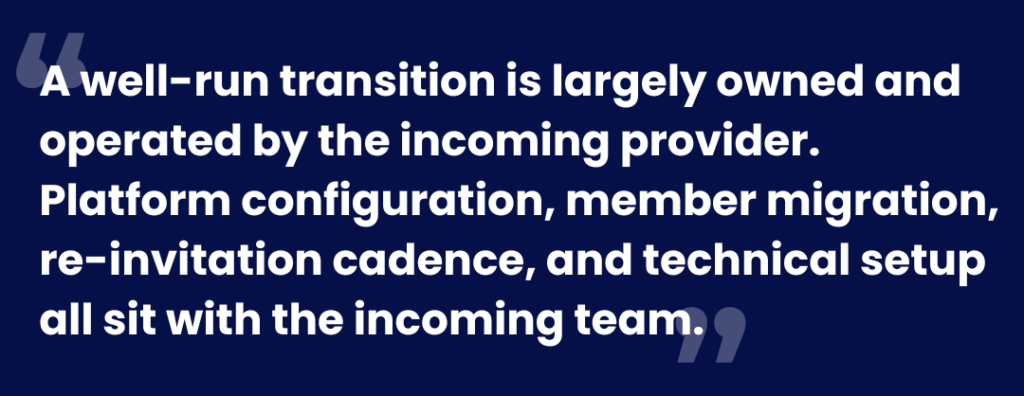
The assumption is that a migration lands on your plate like a major initiative that you have to scope, manage, and execute alongside an already full research calendar. That’s not how it works with the right partner. A well-run transition is largely owned and operated by the incoming provider. Platform configuration, member migration, re-invitation cadence, and technical setup all sit with the incoming team. Your role is a few alignment calls, approval of member communications, and coordinating data export with your incumbent. That’s pretty much it.
Most clients describe the transition as significantly less disruptive than they expected. Not because switching is trivial, but because a partner worth switching to has done this enough times to have it down to a repeatable, low-friction process specifically designed so your team doesn’t get bogged down.
Myth: Switching means putting your research on hold for months
Truth:There’s no gap in your research
A good migration runs in parallel, not in sequence. Your incoming partner stands up the new community while your existing program is still active. You can even field studies with the new provider and fresh recruits before you’ve fully wound down the old one. It’s a best practice to keep the old community up for a few weeks while existing members migrate but there is no need to wait to begin studies in the new community until the migration is complete.
Myth: You’ll lose the members you’ve spent years building relationships with
Truth: Your members come with you
Every member migrates automatically into the new platform. Member profiles, behavioral history, and rewards balances all transfer. A structured re-invitation process guides members into the new experience, and for most of them it feels like a refresh with a new look and exciting new possibilities.
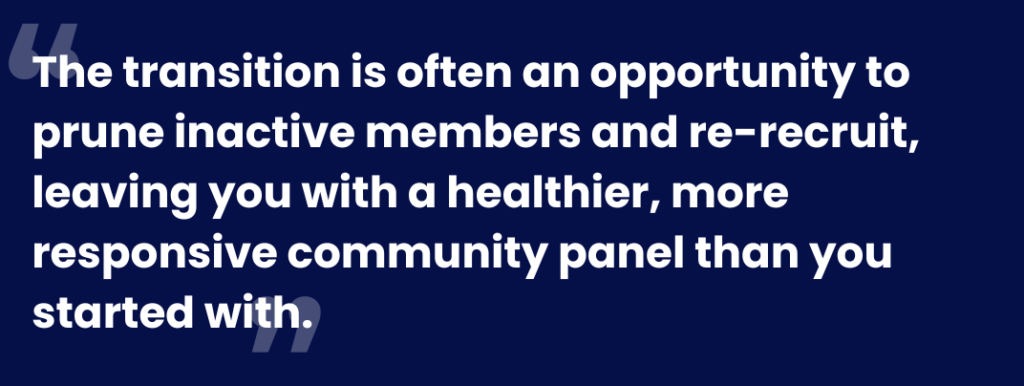
Done well, re-invitation cadences achieve strong re-registration rates. The members who were most engaged before tend to continue to engage right away. And the transition is often an opportunity to prune inactive members and re-recruit, leaving you with a healthier, more responsive community panel than you started with.
Myth: All your historical data stays behind when you leave
Truth: Your data doesn’t disappear
Historical research outputs, programmed surveys, and member data move with you. Past work gets stored in a shared folder system your entire team can access going forward. Most clients end up better organized than they were before they switched because the transition triggers a clean-up that was probably overdue anyway.
A Real-World Example
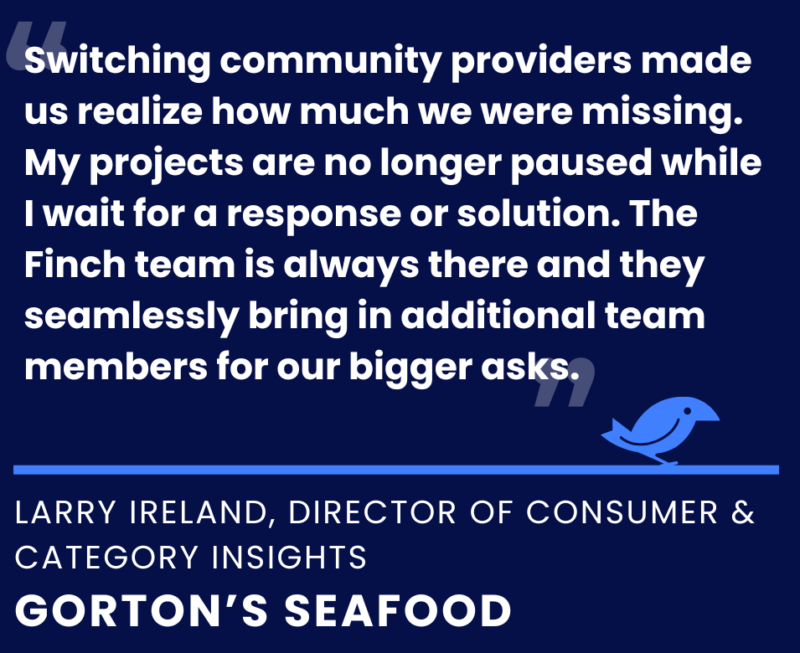
Gorton’s Seafood spent five years with their previous software-first community provider before deciding something had to change. Larry Ireland, Director of Consumer and Category Insights at Gorton’s, described the breaking point plainly: “We got to a point where our account was being managed by the sales team, the platform was buggy and nobody was responsive when we had challenges.”
The fear of switching had kept them in a relationship that had stopped working. Once they made the move, the gap between what they’d had and what was possible became obvious.
The tech mattered. The team mattered more.
Frequently Asked Questions
Will I lose a lot of my community members in the transition?
Not with a well-managed migration. Every member is brought over automatically into the new platform. From their perspective, the site looks different but not much else changes. A strong re-invitation process keeps participation high, and the transition can actually be an opportunity to refresh and re-engage members who had gone dormant.
Do I lose all of my existing data?
No. Member profile data, rewards history, and past research all transfer. Historical work is stored in a shared archive your team owns and can access anytime. Nothing disappears.
Will there be a gap in our research program?
There doesn’t have to be. Incoming and outgoing programs run in parallel during the transition, so fieldwork continues without interruption. You shouldn’t lose a single fielding week.
How much of my team’s time does this actually require?
Less than most people expect. The execution sits with the incoming partner. Your team’s role is mostly alignment calls, approval of member communications, and coordinating data export with the incumbent. That’s the bulk of it.
How long does a migration typically take?
Most programs are up and running within four weeks. Community size and how cooperative your incumbent is are the main variables.
What if our current provider makes it difficult to leave?
Your member data belongs to you. A partner who has navigated transitions before knows how to work through incumbent friction. It’s a solvable problem.
Why do so many insights leaders wait longer than they should?
Because the fear of disruption is loud and the cost of staying is quiet. Staying in a relationship that isn’t working doesn’t show up as a line item. It shows up in research quality, stakeholder confidence, and opportunities you didn’t take because your community couldn’t support them.
At Finch Brands, we’ve built our migration process specifically to minimize the burden on your team and keep your research moving from day one. If you’re wondering whether your current community program is still the right fit, our Insights Community Benchmarking Scorecard is a good place to start.
About the Author
John Ferreira is Chief Insights & Innovation Officer at Finch Brands where he develops the firm’s innovative approaches to research and AI-powered insight. His perspective on insights communities is shaped by genuine dual experience: he spent 11 years at Campbell Soup as a client of a leading insights community firm and has spent the better part of a decade on the agency side solving for the pain points he felt as a client. He holds an MBA from the Wharton School of Business.