Branding Post-M&A – The Key Question of Naming in Brand Architecture

In the wake of a merger or acquisition, M&A brand strategy becomes a declaration of intent: what the combined entity stands for and where it is headed. But the first – and often most visible – signal is the decision of how to handle the corporate name, or the brand architecture.
Brand architecture decisions after an acquisition send immediate cues to customers, employees, and stakeholders about what is changing, what is staying the same, and how the new organization should be understood in a brand merger. Thus, is important to get this decision right.
The Four Brand Naming Strategies
While M&A creates complexity across product portfolios and offerings, the highest-stakes decision often sits at the top: the highest level of M&A brand architecture, the corporate name and identity.
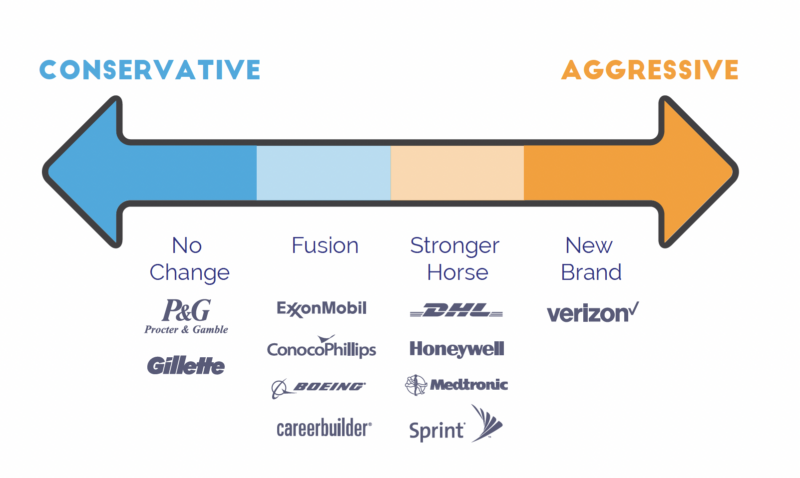
There are four prevailing approaches to brand architecture. The right choice is situational, grounded in business strategy and the relative strength of existing brand equities. Moreover, there are various permutations of each.
-
No Change
Under a No Change strategy, the acquiring company leaves the acquired brand intact – name, logo, and market presence remain independent. While integration may occur operationally, the brands are presented as distinct to the outside world.
This approach works best when each brand is clearly differentiated and carries strong standalone equity – as in a classic “house of brands.” The tradeoff, particularly in B2B environments, is that it can limit cross-selling and dilute the perceived power of the combined entity.
-
Fusion
A Fusion strategy blends identity elements from the merging organizations to create a shared, combined brand.
At its best, Fusion signals unity and a collective future, helping employees and customers feel represented in the new entity. At its worst, it feels like a compromise – awkward, transitional, and lacking clarity. When the combination is forced, the result can undermine both memorability and meaning (ExxonMobil being a classic example).
-
Stronger Horse
The Stronger Horse strategy elevates one brand – typically the acquirer or the brand with greater equity – while the other is phased out over time.
This creates clarity and concentrates investment behind a single identity. But it also introduces risk: stakeholders tied to the “retired” brand may feel diminished or displaced. Success depends on careful migration planning and thoughtful communication to preserve as much equity as possible during the transition.
-
New Brand
A New Brand strategy creates an entirely new identity for the combined entity.
This is most effective in moments of significant market disruption or when neither legacy brand fully captures the future vision under the brand consolidation. It is also the most resource-intensive path, requiring investment, patience, and disciplined rollout. The upside is the ability to define a truly forward-looking position (e.g., the creation of Verizon from GTE and Bell Atlantic).
Choosing the Right Path—and Managing the Brand Transition (After Acquisition)
Each approach carries tradeoffs. The right answer depends on the specifics: company strategy, category dynamics, customer expectations, cultural realities, and the strength of existing brands.
Importantly, selecting the end-state architecture is only half the battle. Most organizations require a deliberate migration plan – one that defines how to move from today’s reality to the desired future state.
Effective migration balances momentum with protection: bringing employees and customers along while safeguarding brand equity. One common tool is an endorsed approach (“[Brand]—a division of…” or “powered by…”), which creates linkage while preserving familiarity. This can serve as either a transitional bridge or a longer-term solution.
Whatever the path, one principle holds: communication is everything. Internally and externally, clearly and consistently.
When managed well, brand architecture doesn’t just reflect strategy – it reinforces it, accelerating alignment, trust, and growth.
To read our full Naming Blog Series, start here!